I originally shared this piece on my personal Substack, but after the response it received, Steven and I both felt it was important to share here as well.
Aphantasia is still relatively unknown, especially when it comes to children and education, yet many people quietly grow up feeling “slow,” confused, or left behind simply because their minds process information differently.
My hope is that this article helps parents, teachers, and even adults who may recognize themselves in these experiences better understand that different does not mean broken.
As an adult nearing my 50s, learning about aphantasia was stunning. Until then, I had genuinely believed phrases like “picture this” were purely metaphorical. Realizing that other people could actually see images in their minds forced me to rethink experiences I had carried my entire life without questioning.
Not long after, I spoke with my youngest son, who also has aphantasia, about how it had affected him growing up.
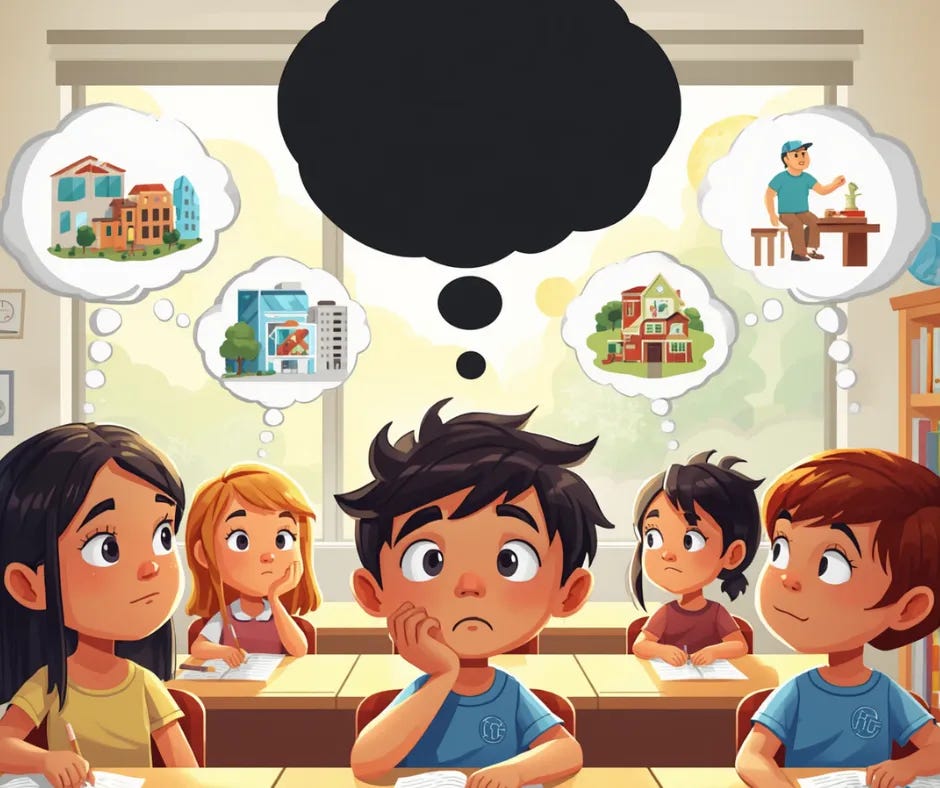
He told me that teachers would often ask students to close their eyes and picture a math problem being solved or imagine scenes during creative writing exercises. He remembered feeling confused and frustrated, like he was somehow failing at something everyone else could naturally do.
He did not have the language to say:
“Wait… I can’t actually see anything.”
Listening to him describe those experiences made me reflect on my own childhood in a completely different way. I remembered struggling with math and certain forms of visual learning and quietly assuming I was simply “slow” or doing something wrong.
What hurt most was realizing how easily these experiences can go unnoticed. Children assume everyone experiences the world the same way they do, so when something feels difficult or confusing, they often blame themselves rather than recognizing a difference they cannot yet explain.
Hearing my son describe years of feeling inadequate was heartbreaking as a mother. At the same time, I realized something equally painful: Before learning about aphantasia myself, I probably would not have fully understood how to help him either.
The Teacher Conversation
I recently attended a parent-teacher conference for my 9-year-old and brought up the topic of aphantasia with his teacher. My son can visualize perfectly well, but I still felt compelled to mention it because of the many students a teacher may encounter who cannot.
She had never heard the term before.
Her reaction was much like most people’s:
“What do you mean you can’t visualize? What do you see?”
Like many people, she was both stunned and curious once I explained it further. We talked about how some people cannot form mental images at all, even though they fully understand the ideas being discussed.
As our conversation continued, she began to realize how often she used phrases like “close your eyes and picture this” or “visualize” while teaching. She admitted she had never considered that some children might not actually be able to do that. She simply didn’t know.
By the end of our conversation, she told me she wanted to learn more about aphantasia, rethink certain aspects of how she teaches, and begin asking more questions so children are not unintentionally left behind.
That conversation stayed with me because it highlighted something important: most teachers are not intentionally excluding anyone. Like most people, they naturally assume everyone can visualize because they themselves can.
Yet visualization is deeply woven into education. It appears in reading comprehension, creative writing, guided imagery, memory techniques, math strategies, spelling instruction, sports training, and even emotional regulation exercises. For children with aphantasia, those moments can quietly create confusion or self-doubt, especially when everyone around them seems to experience these exercises differently.
Aphantasia is still relatively unknown, and unless you have it yourself or know someone who does, there is a good chance you have never even heard of it. Because of that, many children may struggle silently without understanding why certain learning methods feel harder or more frustrating for them.
Awareness matters. Awareness changes language, and language changes how we teach.
That conversation also forced me to reflect on my own experiences in school.
Looking back, there were teachers in my life who misunderstood my struggles, though they likely never realized it at the time. I especially remember a third-grade teacher who was abusive in many ways and was eventually fired. I struggled in her class more than anywhere else.
I was often the slowest student to solve math problems, and she made me feel “slow” or “stupid” because of it. Sometimes she would publicly announce to the class that nobody could have “fun” time until Andrea finished her work.
Those experiences stay with a child.
I do not personally view aphantasia as a disability, though I understand why some people do. To me, it is simply a different way the brain processes information. But when children are misunderstood, singled out, or made to feel inadequate because nobody recognizes those differences, the emotional impact can last long after childhood ends.
What Aphantasia Might Look Like in a Child
One of the hardest things about recognizing aphantasia in a child is that nothing may seem obviously “wrong” at all.
Many children adapt quietly. Some develop strong verbal skills, rely heavily on facts or concepts, or create workarounds without ever realizing they are approaching things differently from other children. Others may simply assume they are bad at certain tasks everyone else seems to understand naturally.
A child with aphantasia may struggle with “picture this” instructions, have difficulty describing visual details from memory, become frustrated during visualization exercises, feel disconnected from certain creative writing prompts, or quietly feel “behind” without understanding why. Some may excel verbally while struggling with heavily image-based learning. Others compensate so well that nobody notices anything at all.
Of course, every child is different, and none of these experiences automatically means a child has aphantasia. Some aphants thrive academically, some struggle. Even among aphants, experiences can vary enormously.
What matters most is not forcing labels onto children or treating every difference as a problem to solve. It is simply recognizing that children do not all think, imagine, process, or learn in the same ways.
And it is not just mental images that can vary from person to person.
Some people can vividly picture images but cannot mentally hear music. Others may mentally replay sounds but not smells or textures. Some experience little or no internal sensory imagery at all.
Sometimes the easiest way to understand how a child experiences the world internally is through gentle, curiosity-led conversation.
Rather than approaching it like a test, it can help to ask casual questions during everyday moments:
“When you think about your bedroom, do you actually see it in your mind, or do you simply know what it looks like?”
“When a song gets stuck in your head, does it sound almost like music playing, or is it more like quietly thinking the words?”
“If I ask you to imagine a lemon, can you almost taste it, or do you just remember what lemons taste like?”
Children who experience strong mental imagery will often answer these questions quickly and naturally. They may describe actually seeing their bedroom, hearing music internally, or almost tasting the lemon.
Children who do not experience those internal senses may instead look confused, hesitate, or describe simply “knowing” rather than mentally sensing the experience itself. Many may never have realized other people experience these things differently.
There is no single “correct” way for a mind to experience memory, imagination, thought, or creativity.
The Ways We Quietly Adapt
Looking back now, I realize I never truly felt “different” growing up because I had naturally developed my own ways of understanding and navigating the world.
I was still learning, remembering, imagining, and processing information. I was simply doing it differently.
Many of the things I now recognize as adaptations never felt unusual to me at the time because they were simply how my mind worked.
One thing I often did was put facts to music.
I remember once watching an episode of Cheers where Coach was helping Woody memorize facts by singing:
“Albania, Albania, borders on the Adriatic.”
I remember laughing because I did things like that constantly.
If I had a big test coming up, I would record questions and answers with soft background music and listen to them while falling asleep or doing chores.
I wasn’t visualizing information.
I was embedding it through sound, repetition, rhythm, and emotional association.
Music helped me tremendously. I’ve always been good at memorizing song lyrics, and when facts were attached to rhythm or melody, I could remember them for years.
Even now, I still remember television jingles, movie lines, poems, riddles, and theme songs from childhood with startling clarity.
Repetition through sound felt infinitely easier than visual studying ever did.
I can now see how heavily I relied on external systems and patterns to navigate the world. I depended on landmarks, repetition, written directions, rhythm, and structured routines rather than mentally “seeing” things internally.
At the time, none of it felt unusual. It simply felt normal to me.
Chess, Visualization & Different Learning Styles
My husband has tried to teach me how to play chess many times over the years, but I have never been able to grasp it well, no matter how hard I tried. I could understand the rules individually, yet once the game became more complex, I struggled to anticipate moves or keep track of the board mentally. Recently, he started teaching our 9-year-old how to play.
Around that same time, I came across a discussion in an aphantasia group where many people described having similar difficulties with chess. Again and again, people mentioned struggling because they could not mentally “see” future moves or visualize changing board positions internally.
For the first time, I found myself wondering whether this was connected to aphantasia too.
Of course, not every person with aphantasia struggles with chess, and some are exceptionally skilled at it. But for many players, visualization plays a significant role in anticipating move sequences and imagining future board positions. When you cannot mentally picture the board, learning may require a very different approach.
Difficulty does not equal inability.
Some aphants learn through repetition, physically moving pieces, pattern recognition, logic, structure, or step-by-step analysis rather than visualization.
That realization also made me think about something else I had always found strange about myself: Despite struggling with chess, I was actually very good at the card game Memory.
Over time, I began wondering whether that was because I had already learned not to rely on internal visual imagery. Instead, I memorized through patterns, placement, repetition, association, and recognition itself.
Rather than mentally “seeing” the cards again, I was remembering relationships and positions.
The more I learned about aphantasia, the more I began noticing these kinds of hidden adaptations throughout my life.
One of the biggest misconceptions about aphantasia is that people assume imagination and visualization are the same thing. They are not.
A person can be deeply imaginative, creative, emotionally perceptive, intelligent, and intellectually curious without forming mental pictures at all.
Language was always one of my strongest areas. I was a strong speller, an avid reader, and often thrived when allowed to learn independently. I absorbed ideas, emotional meaning, patterns, and concepts deeply, even without mentally picturing them.
I realize now that I naturally gravitated toward conceptual and verbal forms of learning while quietly building alternate ways to process and organize information.
At the time, I did not recognize any of it as adaptation.
It was simply how my mind worked.
Ways Parents & Teachers Can Help
One of the simplest and most meaningful things teachers and parents can do is adjust their language.
Instead of saying:
“Picture this.”
It can help to say:
“Think about this.”
“Imagine it in your own way.”
“Describe what you know.”
Small shifts like that can make an enormous difference for a child who may already feel confused about why certain exercises seem harder for them than for everyone else.
Children do not all learn the same way. Some may respond better to verbal instruction, auditory learning, written directions, hands-on activities, diagrams, note-taking, physical manipulation, or external visual references rather than internal visualization.
Sometimes, simply allowing a child to sketch ideas on paper instead of trying to hold them mentally can reduce enormous frustration.
Even classroom discussions can become more inclusive through small changes. When discussing books, for example, teachers can focus not only on visual description, but also on emotion, meaning, relationships, ideas, and interpretation.
Most importantly, normalize different inner experiences.
Children need to hear that people think, imagine, remember, and process information differently, and that different does not mean wrong.
What would have helped me most as a child was simply understanding that there was nothing “wrong” with me. I wish someone had explained that struggling with a particular teaching method did not mean I was unintelligent or incapable.
When I eventually entered an alternative school and was given more freedom to learn independently through reading and physically working problems out on paper, I began excelling academically.
That was not solely because of aphantasia. It was simply the way I learned best.
Still, I can now see how much aphantasia affected experiences I once blamed on personal failure. I remember classroom moments where other children seemed able to solve math problems mentally while I struggled to discreetly count on my fingers, hoping nobody would notice.
What I most hope for teachers to understand is this:
A child may fully understand a concept while struggling with the specific teaching method being used.
That is not laziness.
It is not defiance.
And it is not lack of intelligence.
Sometimes a child is not failing to learn. They may simply be trying to learn in a way their mind was never naturally built for.
And often, small changes in language, flexibility, or approach can make an enormous difference.
Closing
If you discover your child has aphantasia, reassure them that there is nothing wrong with them. Their mind simply works differently.
Talk to their teachers.
Most teachers have likely never heard of aphantasia and may genuinely appreciate having it brought to their attention. Small shifts in language, flexibility, and teaching style can make an enormous difference for a child who may already feel confused or left behind.
My hope for both parents and teachers is simply greater awareness, so children do not grow up believing something is wrong with them simply because they learn or imagine differently.
There is no single “correct” way for a mind to think, create, remember, or imagine.
And sometimes, simply being understood can change everything for a child.
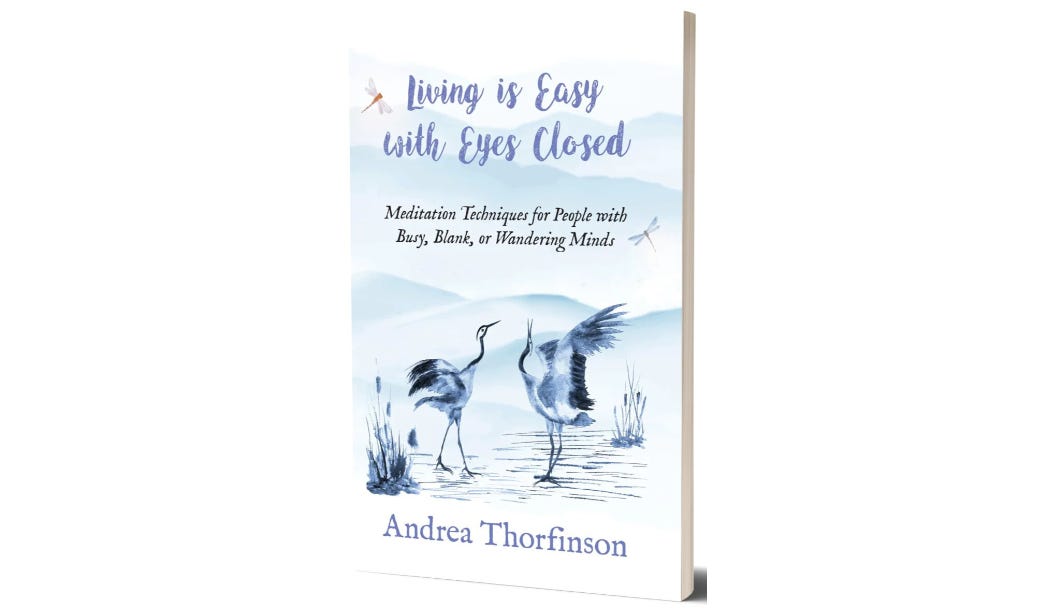
Many of the ideas explored in this article connect deeply to themes I discuss in my book, Living Is Easy With Eyes Closed, where I explore meditation, imagination, non-visual thinking, and accessible approaches to inner experience through personal stories, science, and practical techniques.