In this thoughtful essay, writer Kevin Kane reflects on the nature of music, performance, and the role of the song itself. Drawing on stories from the stage, the recording studio, and the long shadow of artists like Bob Dylan, Kane explores a simple but powerful idea: sometimes the song is the instrument.
From blues harmonica to Broadway orchestras to late-night bar bands, this piece looks at what happens when musicians serve the song—and when they don’t. Along the way, it raises deeper questions about creativity, interpretation, and the strange space where art lives once it leaves its creator.
For the Sake of the Song
The multi-instrumentalist artist known as Guinga has a given name which is impressive. Carlos Althier de Souza Lemos Escobar. Guinga is a Brazilian singer-songwriter, who suggested on NPR, on Jan 4, 2020, that he considered the song he was singing to be one of the instruments that he played, a unique instrument making a sound that expresses ideas and feelings for him—but that before you can play it, you have to first make the instrument. You have to create the song. And then, you have to learn to play it. Seems just what any serious player does, similar to what someone like Bob Dylan has done all along over the years.
“It’s all about the song,” Dylan said one time, adding “My only job is serving the song.” Dylan’s performances and recordings are not about a personality or a rock star up on a stage. They are not about winning his audience’s approval with flashing instrumental ornamentation. Dylan has more often than not totally ignored his audience. He definitely does not invite them to pick up his fragile and precious instruments and manhandle them—in fact he flees from the sound when they try to sing along. It’s all about the song, which is there, and has always been there, whether he played it alone with a six-string guitar when he was starting out, or on some long-ago records let Emmy Lou Harris add her soaring harmonies or let Scarlet Rivera’s gorgeous violin lines feel their way around his voice or let Mike Bloomfield’s electric blues band charge things up. Nothing changed when Dylan went electric. The song remained the same. He was playing songs as instruments—and honoring the song. Usually, the performances sounded great. Sometimes in later years the performances sounded lousy. But the songs were just as good.
The instrument you play, if it’s a song, may have lead guitar riffs, a wailing tenor sax and great bass lines set around it, and it may not. Those other instruments that people play are frames for a work of art and there are lots of them available. In many shapes and sizes. There are lots of players, and many musical instruments available. You don’t need to use them all. The song is just one of the instruments artists can use.
Sometimes the song is not the most important instrument. Jimi Hendrix’s “Crosstown Traffic” was a great piece of art when it came out in the sixties. But the actual song is just a barely sketched out framework, a skeleton—and he used it to hang an electric guitar performance on. In that case the performance itself was the key to the highway. Musical instrumentation on “Crosstown Traffic” included Jimi’s rhythm guitar, played in a pyrotechnic manner that makes it sound like a lead guitar. That’s the genius and beauty of that particular song. It’s the performance that we revel in there. Hendrix could have sung something else, picked another song, because for that particular work of art, the song wasn’t the instrument, the performance with his guitar was the instrument.
On the other hand, with some works of musical artistry, the song is in fact the essential figure, the “crux of the biscuit” as Frank Zappa put it. The reason we are there. And that song can be figurative or abstract. A story related with words and a tune or an image of musical colors and lines. A song can tell you something. Or it can be something. Dylan almost always uses the song as his main instrument. His guitar playing is sometimes rudimentary, and sometimes extraordinary, whether he’s playing rock and roll, or traditional folk or blues, but his guitar playing is not why we are there. His guitar playing doesn’t really matter. If guitar virtuoso Bruce Langhorne had been playing the rhythm guitar for Dylan on his first record, as vague accusations suggest, it wouldn’t be cheating and it wouldn’t make any difference. When the Monkees or the Beach Boys used session musicians in the studio, it didn’t matter either. It was the songs that mattered. And it was the performance, which is also an instrument.
Sonny Terry, the great blues harmonica player, originated a part in a 1947 Broadway play called “Finian’s Rainbow”. The character he played was a black blind harmonica player—and Sonny Terry was perfect for the part, because that’s what he was, a black blind harmonica player. Musical orchestrations were credited to Broadway music-arrangers Robert Bennet and Don Walker, but Sonny Terry marched to his own drummer, and he created his own portion of the score—which he played perfectly as a character on the stage while a ballet dancer danced alone in a dream sequence, halfway through the second act. It was a great little tune that Sonny Terry had come up with and he played it just right every time—just the way he’d created it—which was with room to move.
Sonny Terry was fired soon after the play opened. The problem was that he had created a work of art, a song for the harmonica, not a note-by-note score written on paper with indelible ink. What he actually played in the theater was sometimes in 3/4 time and sometimes in 4/4 time. Sometimes it was a twelve-bar blues and sometimes it was a thirteen-bar folk song. He played with his eye on the same glimmer of light, the light he had seen way off in the distance, when he worked out the piece originally. He did that six nights a week and Wednesday and Saturday afternoons too, standing up there on that Broadway stage—and he played perfectly what he first heard every single time. Having spent his entire life in darkness seemed to present few problems for Sonny Terry when it came to finding a song and playing it right.
Sonny Terry was a great blues harp player. He worked with guitarist Brownie McGee for years and they never had any problem keeping time with each other. They didn’t talk much; in fact, they didn’t speak to each other at all. They’d had a falling out early on and didn’t speak for the last twenty years they toured together. Separate buses, separate hotels, separate dressing rooms. They would meet out on the stage, night after night, and up there, under the white-hot stage lights, Brownie McGee could always play his guitar in close step with Sonny Terry’s harp. Brownie McGee could do it, but the union musicians in that Broadway orchestra pit trying to play along with Sonny Terry’s harp found themselves all over the place. Sonny Terry called what he did “whooping and hollering the blues”. Those Broadway musicians called what they did “playing the notes as written.” It didn’t work out, because they were following the black and white markings on sheets of paper propped open on their music stands rather than following the genius standing there up on the stage playing the tune as he had heard it.
I worked as an actor when I was younger, and I auditioned for and got that same part that Sonny Terry originated—in a revival of “Finian’s Rainbow” produced in a regional theater. I was a young white man playing the part of an old blind black man blowing a blues harp. I was close enough for regional theater—because I could blow a decent blues harp and how many regional actors can do that? I could play the music—and in that production, they needed someone who could play the blues harp more than they needed someone who could play blind or black or old. I tried to play the harmonica part just the way they showed me, note for note, as transcribed by the musical director. They wanted it the way the player on the cast recording had played it and I could make it sound exactly like that—but not every time.
The small regional orchestra they’d engaged, well-trained musicians who were insurance men and shopkeepers by day, went chopping through the night, looking for the dawn, following directions to the letter. We were doing all right. But the poor little ballet dancer trying to hit her marks, moving to the music I was playing, stomping my foot and honking all over the place, was flummoxed. Why, I figured, didn’t she just listen to what I was playing and dance to it?
“Twirl around a little bit more, up on your toes there, if you need to,” is what I wanted to tell her. She was crying one time when she came off the stage. I had really outdone myself, really nailed it that night and I thought she was weeping because we had done so well together. We were really hitting it—there was some life in what we were doing, and everyone there knew it. I felt the pure joy of performing well surging through me. We had gotten down deep to the core of the composition, to the spirit of the song Terry had originally played. I was Sonny Terry, and I was the new south and I had been to the crossroads for a flickering moment. I had been to the mountain! I had heard something on high and I had played it—and maybe I had gotten a little full of myself and tooted my own horn a little more than was written. But how would I know? A twelve-bar blues doesn’t have to have forty-eight beats, does it? The dancer was just swirling away, a dervish in silk veils, she was hearing it too, the song Sonny Terry had heard, coming from some far-off place, and she was moving with her whole mind and body to the whooping joy we both felt as we pushed our way through the darkness. I took the lead, going first, to light our way. And she followed. I thought. It turned out that one of us had messed up badly. Afterwards the dancer and the musical director suggested it was me. I felt bad because she was trying so hard, and there I’d gone and made her cry.
I played more recently, with a great session keyboard player one night in a bar in the Bronx, at some sort of a benefit where he and his band invited solo acts up to join them, to pick a song—any song—and see if they couldn’t play back up. I didn’t want to test them or challenge them. I wanted to play some music. It’s fun to do that with a great house band. They were doing songs from the radio. Lots of hits from the sixties and seventies. I think they covered something by The Ohio Express or maybe it was “Sugar, Sugar” by The Archies. They were good musicians, and they made every song sound just like it had sounded on the radio. I figured I’d do “Quinn the Eskimo”. A little Manfred Mann song I’d heard long ago that Dylan wrote and never released on a studio record. That was in line with what other players were doing that night and would be easy to follow even if you didn’t know it. I got up on the stage and told the keyboard player I was going to be playing “Quinn the Eskimo” in the key of G.
“It’s in C,” he said.
“It is?” I was impressed and I wondered how he knew that. Still, I had sung it in G when I was starting out a long time ago and I had the cross harp already stuck in the rack around my neck.
“Not tonight, it’s not,” I told him. “Tonight, it’s in G.” I thought I was being amusing. It’s a simple song. What do they care what key it’s in? So, I played it in G—and the drummer and the bass player and then the keyboard player kicked in as I played through the progression once and then I really got started, singing the song. Howling along. Not too bad, I thought to myself. Playing cross harp to beat the band in between verses. Then at the end of the second verse, the backup singer with the red hair, shaking her tambourine, leaned over close and hissed in my ear, “It goes up a third at the end of the chorus.” Just trying to be helpful I guess.
“The Might Quinn” is a great little song. I’m banging it out on the guitar, but it’s the song making the sound, not my guitar. My guitar and harp outline the song, decorate it, give it something to sit on, but I am playing a song. As my main instrument. Maybe I’m not doing the Manfred Mann version. But I know that song, and I know what it’s about. It’s about three minutes. Just three chords—and you sort of pound ‘em out. It’s a passion play and a warning. So you sing it with a passion and as a warning. And sometimes you sing it in the key of G. It doesn’t make any difference.
“When Quinn the Eskimo gets here, everybody’s gonna run to him . . .” That’s the score. “G” chords are big and bright. You stroke on one of those for a few bars, then you pull your breath in on the C harp for a bit, get a good head of steam up, huffing and puffing in and out, and then you start singing the song. A little way into it, you change to the “D” chord. And when it feels about right, you go back to the “G” for a degree of resolution. You know when to do it. It’s a great song to hear, and a blast to sing, it brings you right back to the beach blanket you were lying on in 1967 when Cousin Brucie first played it on the WABC top-forty radio, and you didn’t even know it was a Dylan song.
How hard it could it have been to follow me? I wasn’t playing Larry Coryell or Chick Corea up there in 7/11 time. I don’t care what kind of musician you are, if you have any music in you at all, you should be able to listen to me—and bang along. Because I’m not that complicated a player and three-chord rock and roll songs are not that hard to play. And if you don’t know how, I’ll be happy to show you the way.
Some players are sidemen by nature I guess. Players of notes. Their job is to support, to follow. To play it right—and there’s a magazine they make for them to read. I’ll tell you about it. It’s called Guitar Player and they used to have a regular feature, every month, called, “You’re Playing It Wrong.” I used to enjoy Guitar Player magazine, but I think sometimes that it takes a lot of nerve to tell musicians that they are playing it wrong. Maybe actually they’re playing “Purple Haze” right and Jimi was playing it wrong. It’s possible.
The pinnacle for these perfect players is to work behind what’s left of The Five Satins or Tony Orlando for forty or fifty shows a year. That’s what that keyboard player did for a living. I think he had toured with The Letterman or The Dave Clark Five or some group like that. But with me—an amateur if ever there was one, he didn’t have the chops. When I got down from the stage, they played a song by the Monkees—perfectly. Maybe it was “Last Train to Clarksville” that night. But who could remember? I do know that if you closed your eyes, you were on the beach, and it was 1967 again. Sounded cool. Just like it had sounded on the 45-rpm disc I had bought after first hearing it on the radio. Except without the warp and woof that comes from leaving your records in the back seat of the car on a hot day.
The version they played that night probably came in at two minutes and forty-nine seconds, just like The Monkees’ recording did, on that number one single they had released fifty years before. Every inflection just right, picture perfect. I would bet that even the Monkees themselves, as good as they were, with hired session musicians playing Neil Diamond songs written for them to record in the studio, couldn’t have done it any better. The keyboard player explained to me later in the evening what the problem was with what I had done up there. “That’s not how Quinn goes,” he told me.
“Pretty close, though,” I thought to myself. You could play that song slow with a tuba player off to the side and with The Newark Boys’ Choir behind you and it’d still be “Quinn the Eskimo”—the song that Dylan wrote. The exact same song that Manfred Mann did so well and that The Grateful Dead and Phish and Counting Crows and probably Jimi Hendrix all did so well at one point and maybe even The Mantovani Orchestra, who covered it once, except with them it was probably done without the vocal so it wouldn’t scare people stuck in the elevator.
I don’t think Sonny Terry ever played “Quinn the Eskimo”, but if he had, I suspect he would have played it “to the beat of his own drummer,” and it would have been just perfect, “however measured or far away,” from the original version. Because whether he was sitting alone or standing in front of a big Broadway crowd, wherever Sonny Terry sat was the head of table. And however he sang a song, even a Dylan song, it was the song he was serving, every single time. If we had to move ourselves a little, to the right or to the left, to hear it, well that was on us. And if you don’t believe me, ask Guinga.
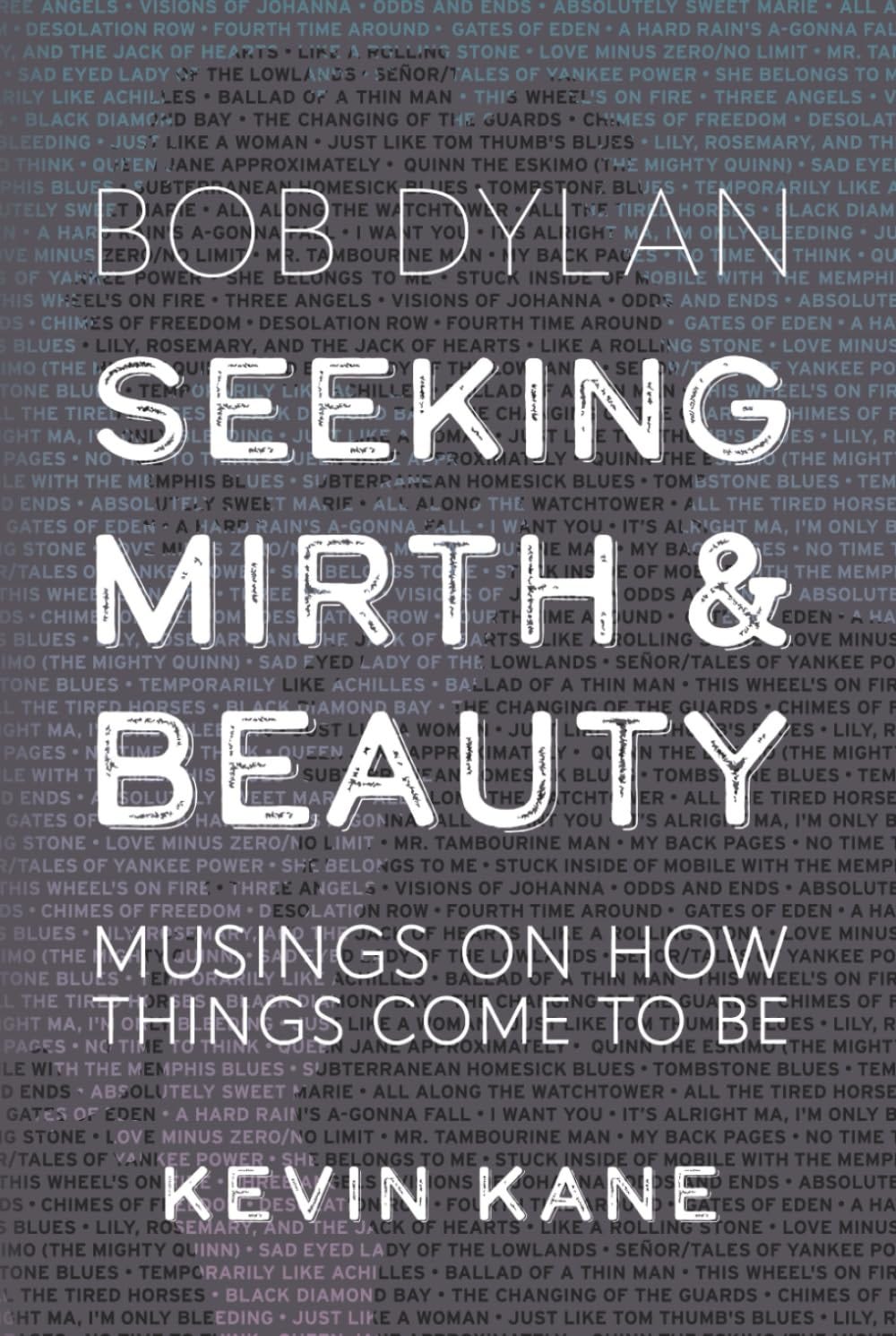
Kevin Kane explores these ideas more deeply in his book Seeking Mirth and Beauty: Musings on How Things Come to Be, a reflective collection of essays on music, creativity, and the enduring pull of artists like Bob Dylan.
Rather than decoding songs or retelling familiar stories, Kane invites readers to consider why certain music stays with us—and how art connects to memory, feeling, and imagination.
Learn more about the book here:
Seeking Mirth and Beauty