


In this next part of my Meditation Myths series, I want to look at two of the most common beliefs that quietly stop people before they ever give meditation a real chance.
Myth #7: You have to visualize.
Myth #8: You have to stop your thoughts.
If either of these has ever made you feel like meditation just isn’t for you, you’re not alone. I believed both of them for a long time, and they kept me from even trying.
If you missed my earlier articles, you can find them here. Part 1, Part 2 and Part 3
Myth #7: You Have to Visualize
When most people think about meditation, they picture something very specific. They imagine closing their eyes and seeing a peaceful beach, a glowing light, or some kind of calm inner scene unfolding in their mind.
But what if nothing appears?
For a long time, I assumed visualization was simply part of the process, and because I couldn’t do it, I believed meditation wasn’t available to me. It wasn’t until I learned about aphantasia—the inability to form mental images—that I began to understand that not everyone experiences their mind in the same way.
And more importantly, I began to understand that visualization is not the point.
It is one way in, not the destination.
Meditation is not about creating images. It is about noticing what is already here.
You can follow the movement of your breath, feel the weight of your body in the chair, listen to the sounds around you, or simply become aware of the steady rhythm of being alive. None of that requires you to see anything at all.
Even for those who can visualize, many find that guided imagery becomes frustrating or distracting, and they walk away thinking they have failed. But nothing about that means meditation isn’t working. It only means they were given one doorway and assumed it was the only one.
It isn’t.
Myth #8: You Have to Stop Your Thoughts
If visualization keeps some people from starting, this belief stops even more.
Somewhere along the way, many of us were given the idea that meditation means clearing the mind completely, as if success depends on reaching a state where no thoughts appear at all.
So we sit down, close our eyes, and within seconds the mind is busy—planning, remembering, worrying—and we assume we’re doing it wrong.
I remember thinking exactly that: How can I possibly meditate when my mind won’t stop?
What I didn’t understand at the time is that meditation was never about stopping my thoughts. It was about seeing them.
Thoughts are not a mistake in the process. They are part of the process.
Instead of trying to force them away, you begin to notice them. You might recognize a thought as worry, or planning, or memory, and in that moment of noticing, something subtle shifts. You are no longer completely inside the thought. You are aware of it.
From there, you gently return your attention to whatever you are using as your anchor, often the breath.
This will happen again and again. The mind will wander, and you will notice, and you will return.
That is the practice.
Over time, the mind may settle more easily, but that quiet is not something you force. It is something that emerges when you stop fighting what the mind naturally does.
When you begin to let go of these expectations, something important opens up.
You don’t need to visualize in order to meditate.
You don’t need to silence your mind.
What you need is far simpler, and at the same time much more meaningful.
You need to notice.
You need to recognize when your attention has drifted and gently bring it back, without judgment and without the belief that you’ve done something wrong.
There is no single right way to experience meditation, only the way that meets you where you are.
Simple Practice
If you want to explore this for yourself, you don’t need anything complicated.
Sit in a way that feels comfortable to you and allow your eyes to close.
Take a slow breath in, and then let it go.
Bring your attention to the feeling of that breath moving through your body. You don’t need to change it or control it, only notice it.
When your mind begins to wander, and it will, simply recognize that it has. You might quietly note “thinking” or “planning,” and then return your attention to your breath.
You can do this for one minute or three. There is no requirement to go longer.
There are no images you need to create and no expectation that your mind will become perfectly quiet.
There is only awareness, returning to itself.
If you’ve ever believed that meditation wasn’t for you because you couldn’t visualize or because your mind felt too busy, those beliefs were never a sign that you couldn’t meditate.
They were simply misunderstandings about what meditation actually is.
And once those fall away, what remains is something much more accessible than most people expect.
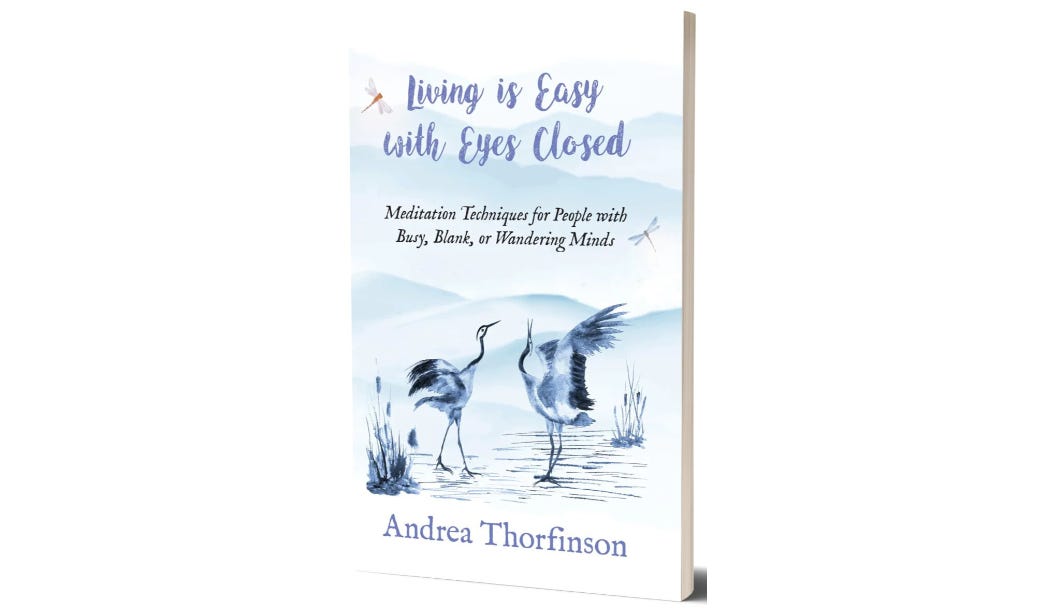
If this way of approaching meditation feels more natural to you, I explore it more deeply in Living Is Easy With Eyes Closed, where I challenge many of the common myths that keep people from starting and share a more flexible, real-world approach to practice.
Always good stuff - so glad I subscribe to these postings!