From the college classroom to the golden era of detective fiction
For many readers, the golden age of mystery begins with names like Agatha Christie, Dorothy L. Sayers, and other celebrated writers of the 1920s and 1930s.
But long before Hercule Poirot gathered suspects in a drawing room, another remarkable era of detective fiction was already underway.
It began with Sherlock Holmes.
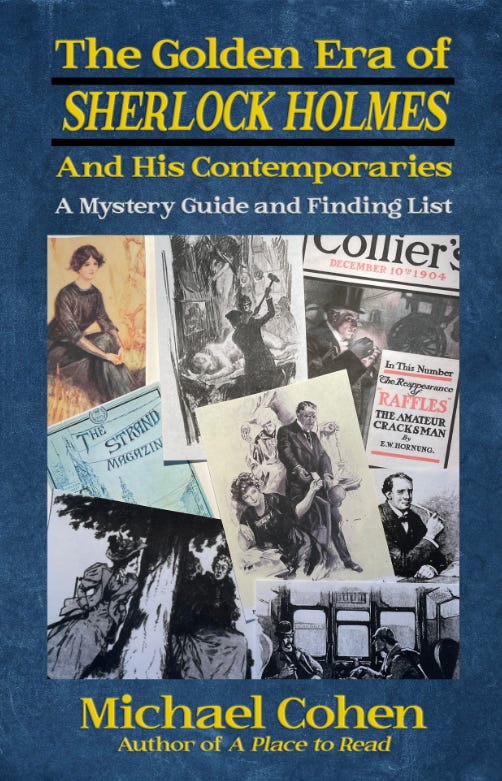
In The Golden Era of Sherlock Holmes and His Contemporaries: A Mystery Guide and Finder’s List, author Michael Cohen takes readers beyond Baker Street and into the world of detectives, rogues, scientists, journalists, occult investigators, and crime-solving women who followed in Holmes’s influential footsteps.
Before turning his attention to personal essays and mystery fiction, Michael spent much of his working life in the classroom.
From Tucson to the Literary Life
Michael grew up in Tucson and attended the University of Arizona. His career later took him to New Orleans and western Kentucky, where he taught college English.
After retiring from teaching, he began publishing personal essays. His collections include A Place to Read, published in 2014, and And Other Essays, published in 2020.
He lives in Lincoln, Nebraska, and in the Tucson Mountains.
Exploring Mystery Fiction
The Golden Era of Sherlock Holmes and His Contemporaries is Michael’s second book on mystery fiction.
His first, Murder Most Fair: The Appeal of Mystery Fiction, was published in 2000. His newest book turns to a particularly rich period in mystery history: the years between the publication of the first Sherlock Holmes short story in 1891 and the end of World War I.
This was an era in which detective fiction flourished in magazines and newspapers. Writers saw the extraordinary success of Arthur Conan Doyle’s Sherlock Holmes stories and began creating investigators of their own.
Some imitated Holmes.
Some exaggerated one of his most recognizable qualities.
Others created detectives who were deliberately unlike him.
The result was a wide variety of characters and approaches to crime fiction, many of which are far less familiar to modern readers.
Beyond Baker Street
Michael’s book begins by examining the qualities that helped make Sherlock Holmes such a literary phenomenon.
Holmes was not simply intelligent. His methods, personality, dramatic deductions, relationship with Watson, and ability to impose order on complicated situations all contributed to his appeal.
Michael is also interested in what happened after Holmes became a success.
What did other writers do with the detective-story conventions Conan Doyle had popularized?
Some created ordinary investigators and removed many of Holmes’s eccentricities. Others took a single Holmesian trait—his skill with disguise, his knowledge of crime, his discretion, or his contempt for the police—and pushed it in a more exaggerated direction.
Some writers responded by creating bumbling detectives who seemed to be Holmes’s opposite.
Others distinguished their characters from Holmes in a more immediate way: they made the detective a woman.
The Women Who Solved Crime
One of the book’s chapters introduces readers to the many female detectives and crime solvers who appeared during this period.
Among them are agency detectives, amateur investigators, journalists, policewomen, and young women who uncover secrets while the people around them underestimate their abilities.
Characters such as Loveday Brooke, Dorcas Dene, Lois Cayley, Lady Molly of Scotland Yard, Judith Lee, Madelyn Mack, and Violet Strange show the range of women investigators appearing in mystery fiction well before many of the genre’s later, better-known female sleuths.
Their stories also offer insight into the way early mystery fiction engaged with questions of gender, work, class, and social expectations.
Scientists, Rogues, and Occult Investigators
The detectives in Michael’s book are not limited to private investigators and police officers.
Some are doctors or scientists who use early forms of forensic investigation. Others are specialists whose knowledge of jewelry, railways, journalism, medicine, or another field helps them notice what an ordinary investigator might miss.
There are also blind detectives, armchair detectives, righteous backwoodsmen, elegant rogues, criminal masterminds, and investigators who confront—or sometimes expose—the supernatural.
The occult detectives featured in the book investigate ghosts, psychic phenomena, haunted houses, and strange events that appear to resist ordinary explanation.
At the other end of the moral spectrum are the rogues: criminals who sometimes pose as detectives, prey upon other wrongdoers, or occupy a more complicated place between villain and hero.
Together, these characters reveal how varied and inventive early detective fiction could be.
A Golden Era of Short-Story Mystery
The decades following Holmes’s rise were shaped in part by changes in publishing.
Magazines increasingly favored short stories over serialized novels, creating new opportunities for writers to develop recurring characters. Detective fiction was especially well suited to the form: each new issue could offer readers another crime, another set of clues, and another solution.
This period lasted for roughly twenty-five years, until World War I brought changes to publishing and to the mystery genre itself. Magazine fiction declined, longer forms became more dominant, and a new era of detective fiction began to emerge.
Many of the writers and characters from the earlier period became less familiar to general readers.
Michael’s book helps guide readers back to them.
Rather than attempting to catalogue every detective story from the era, he focuses on notable examples and provides information that can help readers locate many of the works he discusses. A number of these stories are now in the public domain and available through online archives or modern reprints.
For Readers Who Thought They Knew the Mystery Genre
Sherlock Holmes may stand at the center of this story, but The Golden Era of Sherlock Holmes and His Contemporaries makes clear that he was never standing there alone.
Around him was an entire world of fictional investigators: women and men, professionals and amateurs, scientists and mystics, heroes and rogues.
Some rivaled Holmes.
Some imitated him.
Some reacted against him.
And some helped take detective fiction in entirely new directions.
For readers who love Sherlock Holmes, literary history, classic mysteries, or the discovery of lesser-known characters, Michael Cohen’s book offers a broad and engaging look at an important era in crime fiction.
Discover The Golden Era of Sherlock Holmes and His Contemporaries: A Mystery Guide and Finder’s List by Michael Cohen, available from Genius Book Publishing.