Recently, while reading about another person’s experience with aphantasia, I found myself nodding along at first with little yeps, I totally get that. But the more I read, the more I started thinking about how easy it can be, especially when we first discover aphantasia, to attribute almost everything about the way our minds work to that one difference.
Having aphantasia myself, I know firsthand how jarring it can be to discover that other people can actually see pictures in their minds when you’ve spent your entire life assuming “picture this” was just a figure of speech. Learning I had aphantasia explained a LOT. There have been so many moments since discovering aphantasia when I’ve thought, Ohhhh. THAT explains it.
At first, it brought on a kind of sadness. I am unable to close my eyes and see the face of someone I love. I can’t visually revisit places I’ve been or replay some of my favorite memories like a movie. I can’t picture my children when they were little or call up an image of someone I’ve lost. I can know exactly what a place or person looked like, but I can’t bring that image back and see it again. There was a period when realizing that other people could do those things made me genuinely sad.
But discovering aphantasia also explained so much. Like why I struggled with certain “visual” assignments in school, why I could never “count sheep” during bouts of insomnia, why my memories don’t play like movies, and why visual meditations not only never made sense to me but could be downright frustrating. Eventually I began to wonder about other things, like my difficulty recognizing faces or my terrible sense of direction. Were those connected too? What about the way I approach writing and creativity?
As I continued reading, though, I kept thinking, Wait, does aphantasia really explain that? Or that? It definitely doesn’t explain THAT! And it made me think more seriously about how easily our individual experiences can become explanations for aphantasia as a whole.
Dreaming is a good example. Aphantasia does not mean you cannot dream. Many people with aphantasia report having visual dreams, and while research suggests there may be differences in dream frequency or vividness for some aphants, that’s very different from assuming aphantasia automatically means someone cannot dream.
I have very vivid dreams. They’re not always “visual,” but sometimes they are, and visual or not, I dream regularly. My husband, on the other hand, CAN visualize. Yet he claims he rarely dreams. Every once in a while he’ll remember one, which makes me think it’s probably more accurate to say he rarely remembers his dreams. Either way, here I am, the aphant, regularly remembering mine while the visualizer sleeping next to me rarely remembers his.
Don’t get me wrong, I freely admit that I understand how easy it is to start attributing things to aphantasia, because when I first discovered it, I did the same thing. That kind of discovery can send you down a rabbit hole analyzing your entire life. I started looking at other things I’d struggled with. Difficulty recognizing faces, or my terrible sense of direction—were those aphantasia?
I’ve never been good at doing math in my head. In school, I counted on my fingers or had to write everything down. It was a source of embarrassment for me then, and honestly, I still do it today. So when I discovered aphantasia, I thought, Well, there you go, that’s why. My struggles with visual meditation? Definitely aphantasia! My difficulties with storytelling? I loved that one honestly, I thought I found the answer to why I wasn’t the grand storyteller I’d always dreamed of being.
Except, as time went on, I started questioning some of those assumptions. Starting with the easiest, meditation. If someone is telling me to close my eyes and visualize something I literally cannot visualize, then yes, aphantasia is obviously affecting my experience. But I eventually learned that meditation itself wasn’t the problem. I just needed approaches that didn’t depend on mental imagery, and guess what? There are a lot of them!
Storytelling took me a little longer to concede, because I really, really wanted to be able to blame this one on aphantasia! But eventually I had to say no, aphantasia is not to blame. Storytelling relies not on visuals, but on imagination, the ability to bring the listener or reader into the scene. I CAN do that, I did write a children’s book, after all! It’s just not an especially strong skill of mine, sad to say.
So, no, writing my Mouse book wasn’t a breeze for me. I had to create the visual scenes slowly, and sometimes I pulled out pictures as aids. But I’ve talked to enough writers to realize that even people who can visualize aren’t necessarily sitting there watching a perfectly formed movie in their heads and simply writing down what they “see.” Aphantasia may stop me from being able to “see” the story I’m telling, but it doesn’t stop me from being able to tell one!
I’m sure there are still things I blame on aphantasia that may or may not truly be affected by that. There has been research showing connections between aphantasia and things like face recognition and certain kinds of navigation, so maybe those really are part of the picture for me. But math, for example, do I struggle because I can’t “see” the numbers? Or am I just better with, say… words? Give me something to write, and I’m happy. Give me numbers and expect me to manipulate them in my head and... yeah, not going to happen.
My son, on the other hand, who is also an aphant, is the exact opposite. Words, reading, and spelling have always been harder for him, while numbers and calculations come easily. So maybe aphantasia affects how we do certain things without determining whether we’re actually going to be good at them. Or maybe I’m just bad at math, both things are entirely possible. And shhh... don’t tell my boss I’m bad at math. I work as a bookkeeper!
The point is, I could label everything as aphantasia, just like I chalk every emotional and physical symptom up to menopause these days. 😂 But the truth is, sometimes I’m just moody, not hormonal. Sometimes I forget where I left my phone because I’m thinking about a thousand different things, not because I can’t visually see it in my mind.
I belong to a couple of Facebook groups for aphantasia and have read many stories from different people describing their experiences. A lot of us have overlapping experiences, and I absolutely think there are similarities. Clearly, aphantasia is the inability to create mental images, so that’s naturally going to lead to difficulties in certain areas. But that doesn’t necessarily mean aphantasia causes every difficulty we experience.
That’s actually what I love about the groups. We discuss and question, and sometimes we argue! Often we discover that a lot of us have the same struggle. Other times, we discover that maybe the thing we thought was aphantasia is just one of our own personality traits or quirks.
One example that made me stop and think was drawing. It seems logical that someone with aphantasia might struggle to draw something like a horse because they can’t visualize one. If I can’t picture a horse in my mind, how am I supposed to draw one from memory? Except... how many people who can visualize can accurately draw a horse?
I’m going to use my husband as an example here. As I said above, he rarely dreams, but he CAN visualize. And here’s the funny part. He’s actually a pretty decent artist. But ask him to draw a horse, and it might look more like a brown hippopotamus!
Drawing is a skill that some people have great talent for, while others, like myself, can barely draw a straight line. I don’t think being able to see a horse in your mind is necessarily going to translate into a beautiful replica on paper unless you also have the skill or talent to draw it. Aphantasia can affect drawing from memory. That makes sense, and research supports it. But that’s different from saying that if I’m bad at drawing something, it’s because I’m an aphant.
Memory is another area where this gets complicated very quickly. Aphantasia can affect the way we experience memory. I don’t visually replay my past. If I think about a childhood home, I don’t suddenly see myself standing in the kitchen or watch scenes from my childhood unfold like a movie. But I can recall things that happened, even strange little details, even though I don’t see the memory. I can remember information and the emotions that I may have felt.
And honestly, I think emotion plays a big part in how I remember. Emotions don’t exist only in our heads. We experience them in our bodies too. So often when I’m trying to remember something from childhood, or even an experience that happened last year on vacation, the emotion is the first thing that comes back. I don’t necessarily see the memory, but I can sometimes feel my way back into it.
So, no, I don’t see the memory, and that absolutely has something to do with my aphantasia. But does every forgotten birthday, misplaced object, fuzzy childhood memory, or inability to remember exactly what someone was wearing twenty years ago come from aphantasia? Probably not. People with perfectly vivid mental imagery forget things too. Just ask my husband where his keys are!
Which leads me to SDAM, Severely Deficient Autobiographical Memory. Aphantasia and SDAM can occur together, but they aren’t the same thing. You can have aphantasia without having SDAM, and this is discussed in the Facebook groups frequently. People can have one or the other, or even both, but having one doesn’t automatically mean you have the other.
The more I thought about all of this, the more I wondered about someone who had only recently discovered they had aphantasia. What if one of the first things they encountered focused primarily on everything aphantasia supposedly takes away?
There ARE things I would love to experience. I would love to close my eyes and see the faces of people I love. I’d love to understand what it’s like to replay a memory visually.
There are things about having aphantasia that genuinely suck. But I also don’t want to walk through my life feeling like something is terribly wrong with me. For most of my life, I didn’t even know anything was different. My mind worked the way my mind worked, and I was still able to imagine, dream, create, remember, love, and grieve. I could still make up stories and draw brown horsepotomuses, and I did all of those things without knowing I was missing those “pictures” in my mind.
What I would have wanted when I first discovered aphantasia was hope. I would have wanted someone to tell me that even if there were things my mind couldn’t do in the traditional way, there might be other ways to approach them. Yes, visually guided meditations are out for me, BUT there are so many other options!
The truth is, when I discovered aphantasia, some of it felt like a gut punch. It felt like I was missing out on something everyone else had. If one of the first things I’d encountered had focused only on everything I apparently couldn’t do, without giving me hope or alternative ways to work with my mind, I probably would have felt defeated. I might not have even bothered trying to discover if there was another way.
And yes, in the beginning, just like with menopause, I wanted to blame all my little quirks on aphantasia. But the more I explored and talked to others, the more I began to understand what areas it legitimately affects and what areas are just... me.
So, yes, aphantasia can explain why you can’t see your mother’s face when you close your eyes, but I’m willing to bet it doesn’t explain why you hate wool sweaters. It can change the way you recall your childhood memories, but it’s doubtful that it’s responsible for you walking into the kitchen and forgetting why you’re there. It might change the way you approach drawing, writing, reading, meditation, or creativity, but it doesn’t mean you’re incapable of any of those things.
Discovering and learning about aphantasia has helped me understand myself enormously. Sometimes a trait really is connected to aphantasia, sometimes it’s something else. And sometimes... it’s just me.
What If You Just Need a Different Way?
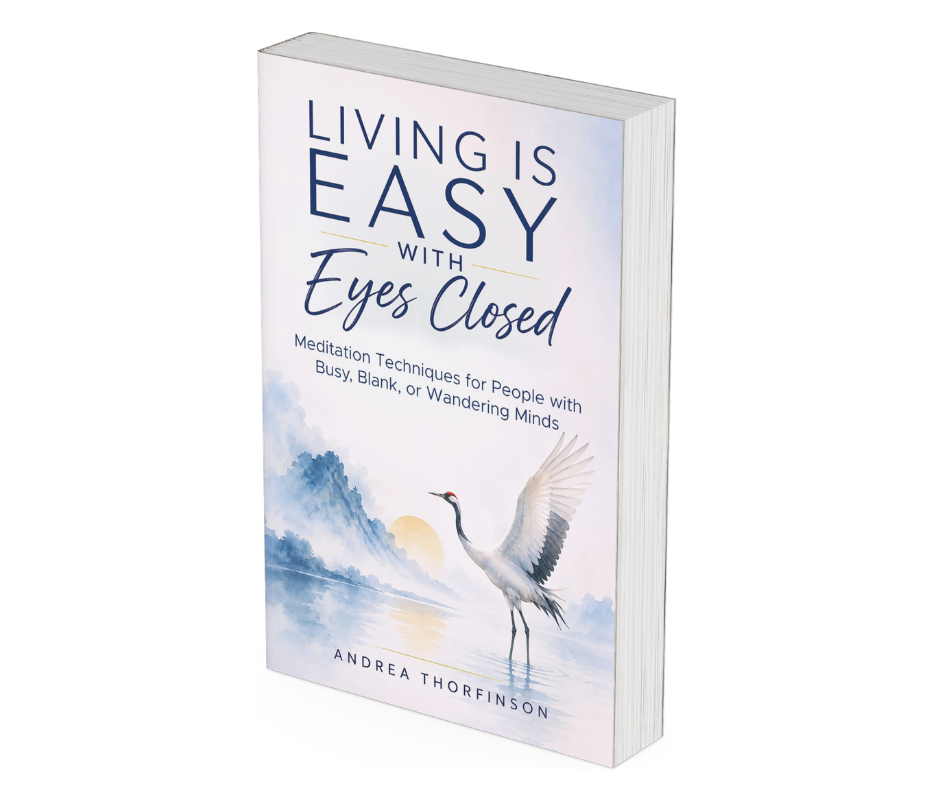
That realization, that struggling with visualization doesn’t mean you’re bad at meditation, is ultimately what led me to write Living Is Easy With Eyes Closed.
I have aphantasia, and for a long time I thought meditation simply wasn’t something I could do. So many practices began with some version of close your eyes and picture... and I couldn’t. What I eventually discovered was that meditation wasn’t the problem. I was simply being taught methods that relied on a mental ability I don’t have.
Living Is Easy With Eyes Closed explores meditation without depending on visualization, using approaches such as breath, sound, movement, mantra, touch, gratitude, and other anchors that don’t require you to see anything in your mind.
If you have aphantasia, or you’ve simply struggled with traditional visualization-based meditation, you don’t have to force your mind to work differently. You can learn to meditate with the mind you already have.
Explore Living Is Easy With Eyes Closed.