


On June 30, 1999, a woman driving past a cornfield near West Alton, Missouri, noticed something in the remote field.
It was the body of a man.
He had been dead for days.
His name was Ricky McCormick, a 41-year-old Black man from Missouri whose life, at first glance, seemed unlikely to draw national attention. He had little money. He could not read or write well. He had never married, though he had children. He had served time in prison. He was often unemployed, living partly on disability, and sometimes stayed with his elderly mother.
No one had reported him missing.
The medical examiner ruled his death “undetermined,” and for a while, it looked as if Ricky McCormick might become exactly what so many forgotten people become after death: a name in a file, a body in a field, a question no one pressed too hard to answer.
But tucked inside the pocket of his blue jeans were two pages of strange, coded notes.
And those notes changed everything.
The FBI’s Cryptanalysis and Racketeering Records Unit studied them. Computers searched for patterns. Experts tried to crack them. The same unit known for breaking wartime codes and solving nearly all the encrypted cases that crossed its desk could not solve this one.
Some dismissed the notes as nonsense.
The FBI did not.
“This is not that case,” one FBI analyst said of the theory that the pages were merely gibberish.
Which leaves the question that still haunts the case:
How did a man who could barely read or write end up carrying a code that stumped the FBI?
THE DEAD MAN’S RIDDLE
On June 30, 1999, a woman driving past a cornfield near West Alton, Missouri discovered the body of a poor black man lying dead in the remote field, dressed in blue jeans and a white T-shirt. A man no one seemed to care about as his body lay decomposed for three days. A high school dropout who never married but had four children. A convicted felon served a year in prison for statutory rape. A father of four children who was never married. A man who was rarely employed and on disability. A man who could not read or write and didn’t own a car. A man still living occasionally at home with his elderly mother. A man who nobody reported missing. The Medical Examiner ruled the death “undetermined.” And there the story appeared to end, just another statistic of a forgotten man of little means.
Yet this obscure man, long forgotten after his death, was about to become an internet sensation. Meet 41 year old Ricky McCormick. Some 30 lines of cryptic notes were found in McCormick’s blue jeans. Cryptic notes that the FBI’s Cryptanalysis and Racketeering Records Unit (CRRU) could not solve, quite a statement since they cracked the codes of Nazi spies during World War II, and successfully solve more than 99 percent of such coded cases.
But not this one.
“Nobody can figure out what any of these codes mean,” said a member of the St. Charles County Sheriff’s Department. “It reads like somebody writing a private diary.”
Or something like that.
(MND MKNE M RSE-N-S-M-KNARE) (ACSM) TFRNE NPINSE NPBSE RCB RNSE NPRSE INC PRSE N MRSE OPRE HLD WLD NCBE (TFXLF TCXLF NCBE) AL-PR PPI T XLY PPIY NCBE MGKSE WLD RCB RNSE PRSE WLD RCB RNSE NT SSNE NTKSE-CRSLE-CITRSE WLD NCBE AL WLD NCBE TSME LRSE RLSE U R GLSNE AS N WLD NCBE (NOPFSE NLSRE NCBE) NTE G D DMN SENCURE RCBRNE (TENE TFRNE NCBRTSE NCBE INC) (FLRSE PRSE ON DE 71 NCBE) (CDNSE PRSE ON SFE 74 NCBE) (PR+SE PRSE ON REDE 75 NCBE) (TF NRCMSP SOLE MRDE LUSE TOTE WLD N WLD NCBE) (194 WLD’S NCBE) (TRFXL). ALPNTE GLSE – SE ER+E VLSE MTSE-CTSE-WSE-FRTSE PNRTRSE ONDRSE WLD NCBE N WLD XLRCMSP NE WLD S TS MEXL DULMT 6 TUNSE NCBEXC (MUNSARSTEN MU NARSE) KLSE-LRSTE-TRSE-TRSE-MKSEN-MRSE (SAEG NSE SE N MRSE) NMNRCBRNSEP+E 2PTEWSRCBKNSE 26 MLSE 74 SPRKSE 29KCNOS OLE 175 RTRSE 35 SLE CLGSE UUNUTKEDKRSE PSESHLE 651 MTCSE HTLSE NCUTC TRS NMRE 99.84.52 UNEPLSENCRSEAOLTSENSKSENRSE NSREONSE PUTSEWLD NCBE (3 XORL) DNMSE NRSE 1N2 NTRLERC BRNSE NTSRCRSNE LSPNSE N GSPSE MKSE RBSE NEBE AU XL ‘R HM CRE N MRE NCBE 1/2 MUNDDLSE D-W-M-4 HPL XDRLX
For the McCormick notes, the FBI used computers and state of the art software to look for patterns. Some 15 to 20 experts were brought in to try tocrack the code. No luck.
“Standard routes of cryptanalysis seem to have hit brick walls,” the FBI said.
And nobody in his family knew what the mystery notes meant. And to believe that McCormick was the author is to believe that a semi-literate man who could barely spell his name has stumped the FBI with 30 lines of coded text. Many people look at the notes and laugh, thinking they mean nothing.
“We look at a lot of things that are gibberish, arbitrary strikes on a keyboard,” Dan Olson of the FBI said. “This is not that case.”
“You are talking about a mentally ill man having complex ciphers in his possession,” a detective close to the case told me. “How does that happen?”
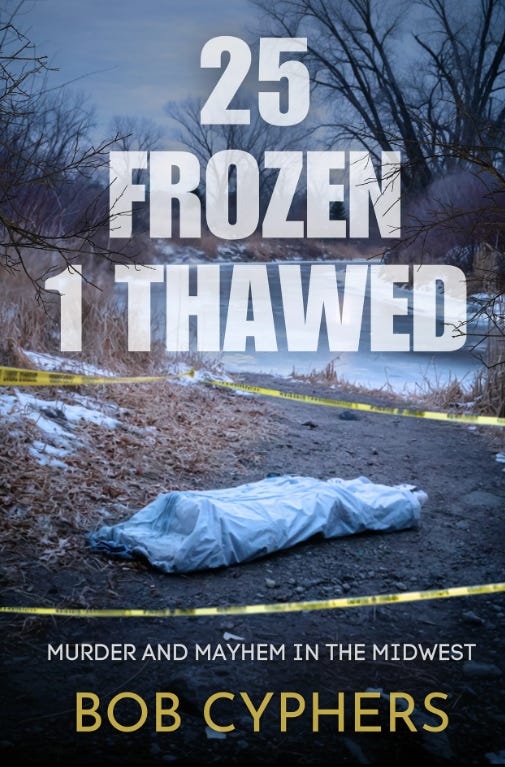
Ricky McCormick’s strange and unsettling case is one of the mysteries explored in Bob Cyphers’ 25 Frozen, 1 Thawed, a true crime collection that digs into murders, disappearances, and unsolved cases from the Midwest with a journalist’s eye and a deep respect for the people left behind.
For readers who are drawn to cold cases, unanswered questions, and the human stories behind the headlines, this is one to add to your shelf.

This is really interesting, man. These kinds of mysteries fascinate me.
Same here! The fact that even the FBI couldn’t crack the notes makes this one especially fascinating and unsettling.