

The shadow of Sherlock Holmes stretches far beyond 221B Baker Street. In The Limehouse Golem, that influence takes on a grisly edge.
Set in the fog-drenched alleys of Victorian London, this 2016 tele-movie weaves music halls, murder, and literary intrigue into a tale that would make Holmes himself raise an eyebrow.
In this edition of Beyond Baker Street, we dive into a story where Karl Marx is a murder suspect, Dan Leno takes center stage, and a detective races against time to solve a brutal series of killings.
It’s murder, mystery, and music hall mayhem—and it’s exactly the kind of tale Holmes fans crave.
Beyond Baker Street IX
The Music Hall Murders
The Limehouse Golem
The influence of Sherlock Holmes in film and television extends beyond the confines of Baker Street. The shadowy streets and enigmatic characters that populate these shows echo the world of Sherlock Holmes and Dr. Watson, yet they carve out their own distinct narratives, rich in mystery and intrigue.
One such tele-movie is The Limehouse Golem (2016). The Limehouse Golem is a gaslight-mystery-horror film based on the novel Dan Leno and the Limehouse Golem, written by Peter Ackroyd. Directed by Juan Carlos Medina, the film stars Bill Nighy, Olivia Cooke, Douglas Booth, Daniel Mays, Sam Reid, and Eddie Marsan. The story, which is set in 1880, opens with a playwright named John Cree (Sam Reid) found dead in his bed—a suspected suicide. However, when it’s discovered Cree’s wife, Lizzie (Olivia Cooke) prepared a poisoned sleeping draft for her husband, Constable Flood (Daniel Mays) has no choice but to arrest her on suspicion of murder.
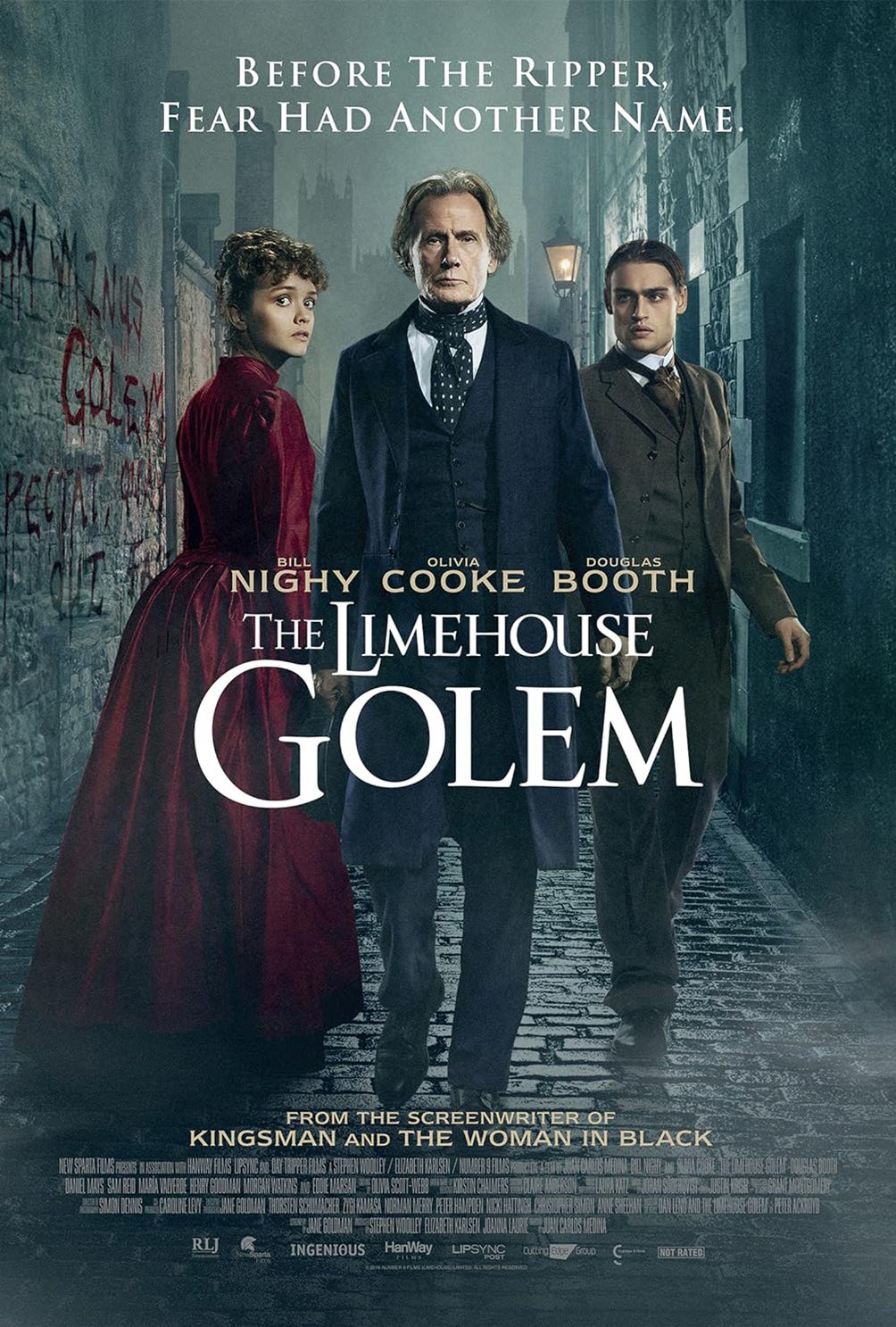
Meanwhile, Inspector Kildare (Bill Nighy) is assigned to take over the investigation of a series of grisly murders attributed to a man dubbed by the press the Limehouse Golem. The Golem’s latest victims were a family of five. At the crime scene a phrase is scrawled on the wall in blood. Kildare recognises the phrase from Thomas De Quincey’s essay On Murder Considered as one of the Fine Arts. Seeking information, Kildare ventures to the National Library, and finds the library’s copy of the book has been defaced by the Golem with notes on the murders inside. Kildare deduces the Golem must be one of the four men who were in the library on the date of the killer’s last murder. The suspects are Dan Leno, Karl Marx, George Gissing and John Cree.
Kildare then takes an interest in the Lizzie Cree case because he suspects she may have murdered her husband because she discovered he was the Limehouse Golem. On death row, Lizzie recounts how she first met John Cree, when she used to work in a music hall along with fellow actor Dan Leno (Douglas Booth)—who is also a suspect for the Golem murders.
Dan Leno (the stage name for George Wild Galvin) was a leading English music hall comedian and musical theatre actor during the late Victorian era.
The Limehouse Golem is violent and bloody, but it’s a well mounted production, strong on period detail and atmosphere.
Beyond Baker Street
I’ve always been fascinated by the shadow cast by Sherlock Holmes—a figure so iconic that his influence seeps into unexpected corners of pop culture. Beyond Baker Street is where I chase those echoes. Whether it’s a villain who once faced Holmes or a story that feels like it should’ve, this series lets me explore the strange tributaries that flow from the great detective’s world.
If you’ve enjoyed this piece, you’ll find even more to explore in my book Baker Street: The Curious Case Files of Sherlock Holmes—a deep dive into 100+ years of Sherlock Holmes in print, film, television, and beyond. From Conan Doyle’s original stories to pastiches, parodies, and pop culture echoes, it’s a must-read for Holmes fans and curious minds alike.
Yours in the Spirit of Adventure
David Foster is an Australian best-selling author who writes under the pen names James Hopwood, A.W. Hart, and Jack Tunney. Under the latter, he has contributed three titles to the popular Fight Card series. His short fiction has been published in over 50 publications worldwide, including by Clan Destine Press, Wolfpack Publishing, and Pro Se Productions, to name but a few. In 2015, he contributed to the multi-award-winning anthology Legends of New Pulp Fiction, published by Airship 27 Publishing.
Foster’s non-fiction work appeared in the award-winning Crime Factory Magazine, as well as contributing numerous articles exploring pulp fiction in popular culture to Girl Gangs, Biker Boys, and Real Cool Cats: Pulp Fiction and Youth Culture, 1950 to 1980 (2017, PM Press) and Sticking It to The Man: Revolution and Counterculture in Pulp and Popular Fiction, 1950 to 1980 (2019, PM Press). He has also contributed articles on the ANZAC war experience to Remembrance (2024, Union Street 21).
Foster lives in the old Pentridge Prison Complex, behind high grey stone walls, in inner-suburban Melbourne, Australia.
Grab your copy of Baker Street today!
