

Before Holmes ever lit his pipe at 221B Baker Street, another detective made literary history. In this week’s Beyond Baker Street, we explore Wilkie Collins’s The Moonstone—a suspenseful masterpiece often hailed as the first modern detective novel. Its impact still reverberates through mysteries and thrillers today, including those of Arthur Conan Doyle himself.
Beyond Baker Street XIII
The First Great Detective Novel
The Moonstone
Many stories vie for the title of the “first modern detective story.” Some people believe it’s Edgar Allan Poe’s short story Murder in the Rue Morgue, which was published in 1841. Others believe it’s The Moonstone, by Wilkie Collins, which was published in 1868. About The Moonstone, T. S. Eliot famously stated:
“... the first, the longest, and the best of modern English detective novels...”
It’s been suggested that Wilkie drew on the real-life Constance Kent murder case for elements of his story. The Kent murder case was also the basis for Kate Summerscale’s narrative non-fiction novel The Suspicions of Mr Whicher (2008).
The Moonstone has been adapted for film and television numerous times. The first film, which is now considered a lost film, was made in 1909. The story was filmed again in 1915 and 1934. It was adapted for television in 1959, 1972, 1976, 1996, and 2016. In 1972, a version entitled, La pietra di luna, was made in Italy; and a German version entitled, Der Monddiamant, was screened in 1974.
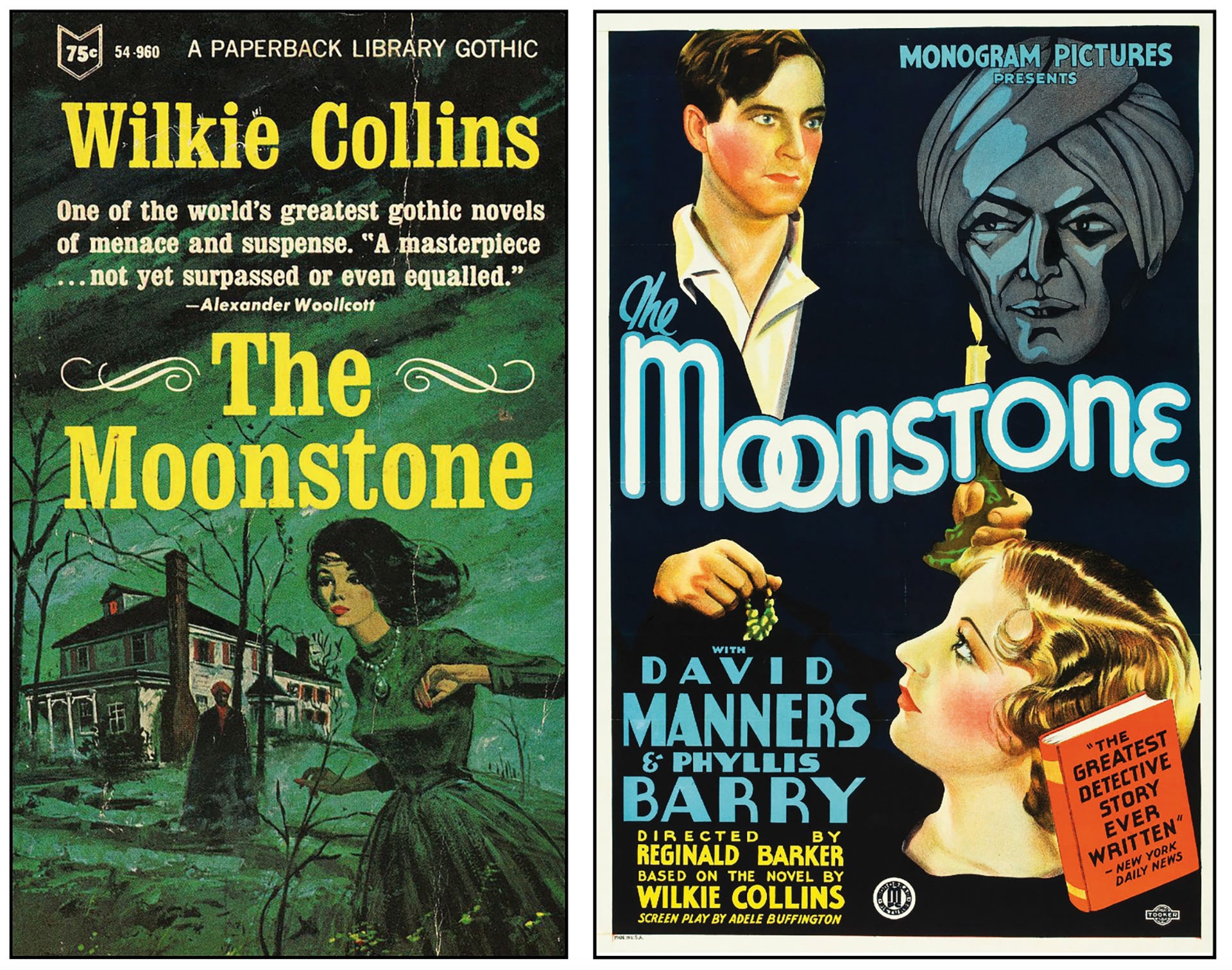
The 1934 version of the oft told story begins with Inspector Cuff (Charles Irwin) being sent to Vandier Manor, to ensure that the Moonstone—a priceless diamond—which is in the possession of Franklin Blake (David Manners), who has just arrived in the country, is protected. Blake gives the diamond to his fiancée, Ann Verinder (Phyllis Barry), who sleeps with the diamond under her pillow. The next morning, she finds the diamond has been stolen.
Many detective stories owe a lot to Wilkie Collins’ The Moonstone—including the Sherlock Holmes mysteries. Many people have noted the similarities between The Moonstone and Conan Doyle’s The Sign of Four.
It was also the inspiration for Sam Siciliano’s 2017 novel The Further Adventures of Sherlock Holmes: The Moonstone’s Curse. In the Author’s Preface, Siciliano stated:
... I can heartily recommend Wilkie Collins’s The Moonstone. Published in 1868, it is generally acknowledged as the first mystery novel, and its detective, Sergeant Cuff of Scotland Yard, would have prodigious number of twentieth-century descendants. The novel’s ingenious plot has a clever twist worthy of Dorothy L. Sayers or Agatha Christie.
The Moonstone may not have the speed or polish of today’s thrillers, but it more than earns its place as the godfather of the modern detective novel. With its labyrinthine plot and a mystery that genuinely unfolds rather than explodes, Wilkie Collins crafted something enduring and oddly addictive. It’s a book that rewards patience, rewards re-reading—and proves that the roots of the genre were tangled, clever, and surprisingly right from the start.
Beyond Baker Street
I’ve always been fascinated by the shadow cast by Sherlock Holmes—a figure so iconic that his influence seeps into unexpected corners of pop culture. Beyond Baker Street is where I chase those echoes. Whether it’s a villain who once faced Holmes or a story that feels like it should’ve, this series lets me explore the strange tributaries that flow from the great detective’s world.
If you’ve enjoyed this piece, you’ll find even more to explore in my book Baker Street: The Curious Case Files of Sherlock Holmes—a deep dive into 100+ years of Sherlock Holmes in print, film, television, and beyond. From Conan Doyle’s original stories to pastiches, parodies, and pop culture echoes, it’s a must-read for Holmes fans and curious minds alike.

Yours in the Spirit of Adventure
David Foster is an Australian best-selling author who writes under the pen names James Hopwood, A.W. Hart, and Jack Tunney. Under the latter, he has contributed three titles to the popular Fight Card series. His short fiction has been published in over 50 publications worldwide, including by Clan Destine Press, Wolfpack Publishing, and Pro Se Productions, to name but a few. In 2015, he contributed to the multi-award-winning anthology Legends of New Pulp Fiction, published by Airship 27 Publishing.
Foster’s non-fiction work appeared in the award-winning Crime Factory Magazine, as well as contributing numerous articles exploring pulp fiction in popular culture to Girl Gangs, Biker Boys, and Real Cool Cats: Pulp Fiction and Youth Culture, 1950 to 1980 (2017, PM Press) and Sticking It to The Man: Revolution and Counterculture in Pulp and Popular Fiction, 1950 to 1980 (2019, PM Press). He has also contributed articles on the ANZAC war experience to Remembrance (2024, Union Street 21).
Foster lives in the old Pentridge Prison Complex, behind high grey stone walls, in inner-suburban Melbourne, Australia.
Find the book here… Baker Street

David Foster's Post is very interesting.