Some crimes become part of a place.
They settle into local memory, passed down through families, whispered about in old barns, and tied forever to a stretch of land where something terrible once happened. Over time, fact and legend begin to blur—but the questions remain.
The Saxtown murders are one of those cases.
More than a century later, the story still carries the same unsettling weight: a family lost, a community changed, and a mystery that never found its answer.
THE AX IN THE SAX
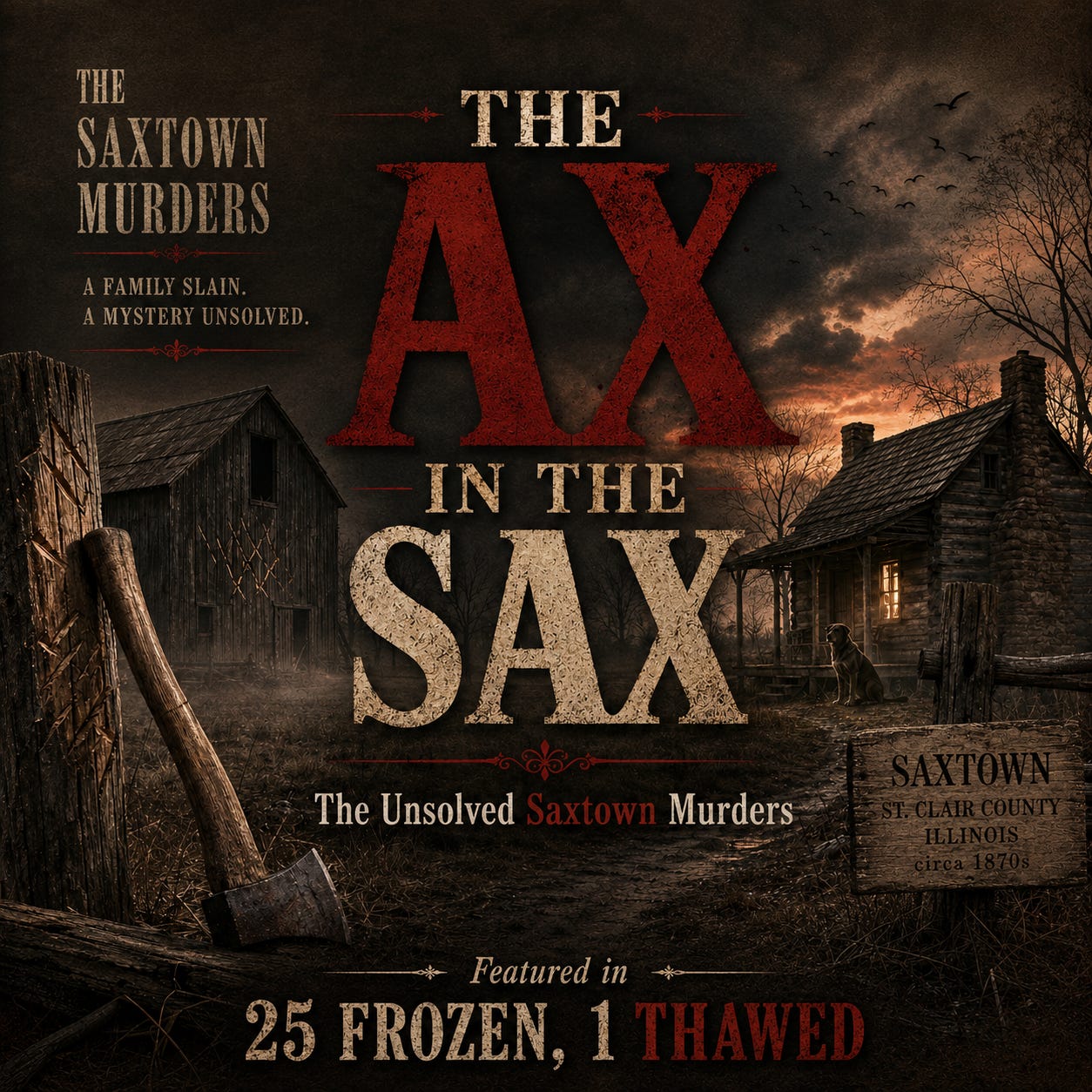
The Stelzriede family immigrated to Southern Illinois, like many others, from Germany. They settled in a small rural track of land known as Saxtown, about five miles south of what is now Millstadt, Illinois, which remains steeped in German heritage today.
On March 20, 1874, Benjamin Schneider needed to pick up some potato seeds that he had purchased from the Stelzriede family. At 5 p.m., he ventured to his neighbor’s small log cabin home, a one story home facing east, set back from the road. The family farm was a large one, indicating the Stelzreides were better off than most. Schneider noticed the Stelzriede land was quiet. Nobody was bustling around doing the family chores. The horses and cattle had not been watered or fed. Schneider knocked on the front door. There was no answer. He looked in the windows. Nothing. Schneider went back to the front door and walked inside. What he found was the aftermath of a crime so gruesome, it would eventually captivate the entire nation.
70 year old Carl Stelzriede was lying in a large pool of blood, throat cut from ear to ear, his body nearly decapitated. In the next room was his 35 year-old son Frederich, who the family called “Fritz.” His skull was crushed and his throat slashed. His fingers had been cut off, and were next to his body. Next to him was his 28-year-old wife Anna and their children, three-year-old Karl, and eight-month-old Anna. All had been bludgeoned to death, believed to be by an ax.
Word of the Saxtown murders blared on the front page of the New York Times. The nearby Belleville Advocate joined the chorus. “An investigation revealed a scene that would make the stoutest heart quail,” the paper screamed.
There was one survivor to the carnage of Saxtown, the family dog, Monk. He was found lying on the floor, quietly keeping watch over the bodies. Monk was said to be vicious toward strangers, so police believed the murderer was someone who was friends with the family.
Two men would be charged with the murders. Both were found not guilty. Eight more suspects would eventually be arrested. All ended up being released. The entire tiny town was under suspicion.
The barn that hosted the horses and cattle on that gruesome night still stands tall, with hatchet marks still visible in the wood. In 1986, Randy Eckert, who lives nearby, bought the land and built a small house on the cabin site. Eckert, who was raised in Millstadt, was always intrigued by the legend of Saxtown.
“I always wanted to buy that farm,” Eckert said. “In fact, I decided to live in the house for a couple of years.”
That did not last long. Every year around the anniversary of the killings, Eckert said he and his wife noticed strange things happening. That was enough for Eckert, who moved out and has since decided to rent the home out. For some reason, the renters don’t stay long. Eckert said he’s probably had a dozen people move out. Many of them reported strange occurrences, always around the anniversary of the killings.
The Saxtown murders are one of the haunting Midwestern cases explored in Bob Cyphers’s 25 Frozen, 1 Thawed: Murder and Mayhem in the Midwest.
Drawing on decades of journalistic experience, Cyphers revisits murders, disappearances, and mysteries that continue to trouble families and communities long after the headlines have faded. With meticulous research and compassion for the victims, he looks beyond the evidence to the human lives forever altered by each crime.
Discover the forgotten cases, unanswered questions, and chilling stories that refuse to remain buried.
Order 25 Frozen, 1 Thawed from Genius Books