When my son Jude was about five years old, he had already spent months hearing me announce, “I’m going to meditate.” Then he would watch me disappear behind a closed door, sometimes for ten minutes and sometimes for much longer.
One day, his curiosity finally got the better of him.
“Mom, what is meditate?”
I paused, trying to think of a way to explain meditation to a five-year-old. At the time, Jude was deeply invested in superheroes, so I answered in language I knew he would understand.
“Meditation is Mommy’s superpower.”
That got his attention.
I explained that meditation helped me use my breath to calm down when I was angry, relax when I felt overwhelmed or scared, and find a little comfort when I was sad.
He considered that for a moment, said, “Oh,” and went on with his day.
A few weeks later, I was preparing for my afternoon meditation when he appeared beside me.
“Mom, can I meditate too?”
I will be honest: I was having a difficult day, and I had been looking forward to being alone.
But how do you say no to a request like that?
You don’t.
I invited him into my room.
I had occasionally thought I might introduce meditation to him one day. I simply had not expected that day to arrive when he was five, and I had no carefully planned lesson ready.
So I did what parents often do.
I made it up as I went along.
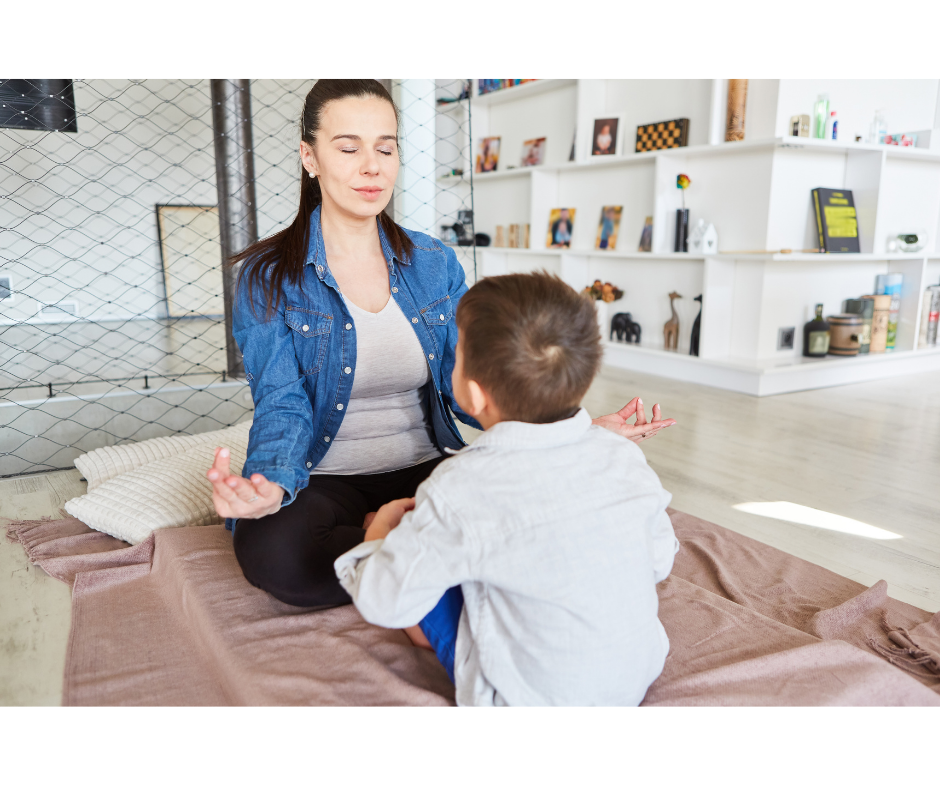
He sat cross-legged on the floor across from me. Before we began, I told him we were going to sit quietly and pay attention to our breathing. I also told him he could stop whenever he wanted. If he felt finished after three breaths, he could leave after three breaths.
I wanted meditation to feel like an invitation, not another thing an adult was making him do.
I rested my arms on my knees with my palms facing upward and invited him to place his small hands in mine. We kept our eyes open.
“Take a deep breath in,” I said. “Hold it for just a second. Now let it out as though you’re blowing out birthday candles.”
He smiled and giggled, then quickly grew serious again.
“Now let your breath return to normal. Notice the air coming in through your nose.”
I gave him a moment.
“Can you feel it?”
He nodded.
“See whether you can feel the breath moving down into your belly.”
He nodded again.
“Now follow it back out.”
He sat very still, concentrating deeply.
“Do you feel it?”
Another nod.
“That’s meditation.”
He looked surprised.
“But that’s so easy!”
I laughed.
“Yes,” I told him. “It really can be.”
We sat together for a few more breaths. I was not doing much meditating myself. I was watching him and noticing how seriously he followed the movement of his breath.
After a short while, I asked whether he wanted to continue, learn something new, or finish for the day.
He was finished.
He got up, quietly left the room, and I continued my own practice.
That first meditation lasted only a few minutes, but it was enough. Over the next several weeks, he occasionally asked to join me again. Sometimes he stayed for only a few breaths. Other times, he sat beside me until I finished.
Eventually, he announced that he was ready to learn something new.
I did not think a five-year-old needed a long explanation about observing thoughts, releasing them, and returning attention to the breath. Instead, I turned meditation into a listening game.
I invited him to close his eyes and notice as many sounds as he could: sounds outside the house, sounds in another room, sounds nearby, and even the sound of his own breathing.
We competed to see who could hear the most.
He won.
His ears were much sharper than mine, and he loved the game.
I did not follow a formal program or a carefully ordered curriculum. I simply responded to his curiosity and tried to keep the practices brief, playful, and understandable.
His interest came and went, as children’s interests often do. Sometimes he joined me frequently. Other times, months passed without him asking. Eventually, sitting silently beside Mom lost some of its novelty.
I assumed meditation had quietly faded into the background of his childhood.
Then he and his best friend had a fight.
Jude was furious and crying with large, full-body sobs. I gently gathered his hands, brought them toward his heart, and held them in mine.
“Let’s breathe,” I said.
Together, we breathed in through our noses and released the air with long sighs through our mouths.
Again and again, we breathed.
Slowly, his sobs eased. His breathing became steadier. His body began to settle. Once the intensity had passed, we continued with softer, more natural breaths until he felt calm enough to talk.
That was one of the first times I saw the practice move beyond our quiet moments together and become something he could use when his emotions felt too large for his body.
Some time later, a close friend of my husband’s died suddenly. Jude had loved him and took the loss hard. Around the same time, he began having nightmares.
One night, I walked past his bedroom and heard him crying and breathing heavily. My first instinct was to rush in, hold him, and make everything better.
Then I noticed something that stopped me in the doorway.
He was sitting with his eyes closed and one hand over his heart. Even through the sobs, I could tell he was deliberately following his breath.
He was using what I had taught him.
I stood there silently for a moment as he slowly brought his breathing under control.
Then I went to him.
The breathing did not erase his grief. It did not make the nightmare disappear or remove his need for comfort.
But it gave him something to reach for inside himself.
It helped him feel his body, slow his breathing, and begin returning to a sense of safety until I could be beside him.
Until that moment, I had not understood how much he had absorbed from those early practices. I had not realized I was giving him something he might one day use when I was not in the room.
Jude is nine now, and he has not formally meditated with me for quite some time. Sitting silently beside Mom is no longer quite as exciting as it was when he was five.
But the practice did not disappear.
When he is grieving, angry, scared, frustrated, or overwhelmed, I can still say, “Let’s breathe,” and he knows exactly what I mean.
He has also come home from school and told me that he became upset during a disagreement but paused and took a few breaths the way I taught him.
To me, that matters far more than whether he develops a regular meditation practice at nine years old.
The goal was never to turn him into a tiny meditator who sat quietly beside me every day.
It was to give him a tool he could carry with him.
As parents, grandparents, teachers, and caregivers, we spend so much time trying to prepare children for life. We teach them to look both ways before crossing the street. We teach them how to ask for help, what to do in an emergency, and how to care for their bodies.
But many of us were never taught what to do when anger surges through us, when grief sits heavily in our chest, or when fear makes it difficult to think.
We learned those lessons while living them—if we learned them at all.
Teaching Jude also made me think about my older son, who struggled for years with intense anger and violent outbursts. At the time, I knew nothing about meditation or nervous-system regulation. I did not understand breathing practices, how to help a child settle an overwhelmed body, or the value of introducing simple tools before emotions became unmanageable.
I wish I had.
I do not believe meditation would have solved everything. Some children need far more support than a breathing exercise can provide, and offering meditation should never become a way of minimizing serious emotional or behavioral needs.
But I do wonder whether having even one small way to pause, settle his body, or feel less overtaken by anger might have helped.
We cannot prevent every argument, nightmare, loss, disappointment, or terrible day at school. We cannot always make the hurt disappear. And we will not always be beside our children at the exact moment life feels too big. What we can do is help them build a small bridge back to themselves.
One breath.
Then another.
A hand resting over the heart.
A moment spent listening to the sounds in the room.
A reminder that feelings can be powerful without being permanent and that they do not have to act from the very center of the storm.
Some children may use these tools only occasionally. Others may need them often. Either way, learning to pause, breathe, and reconnect with the body can become a meaningful part of a child’s emotional toolbox.
Perhaps Jude will return to meditation more regularly one day. Perhaps he will ask me to teach him something new. Maybe he will eventually create a practice that looks nothing like mine.
For now, I am simply grateful that he knows how to pause.
His breath will always be with him.
And sometimes, years after a small child first asks, “Mom, what is meditate?” we may find ourselves standing quietly in a doorway, realizing they have already begun learning how to find their own way home.
A Note for the Grown-Ups
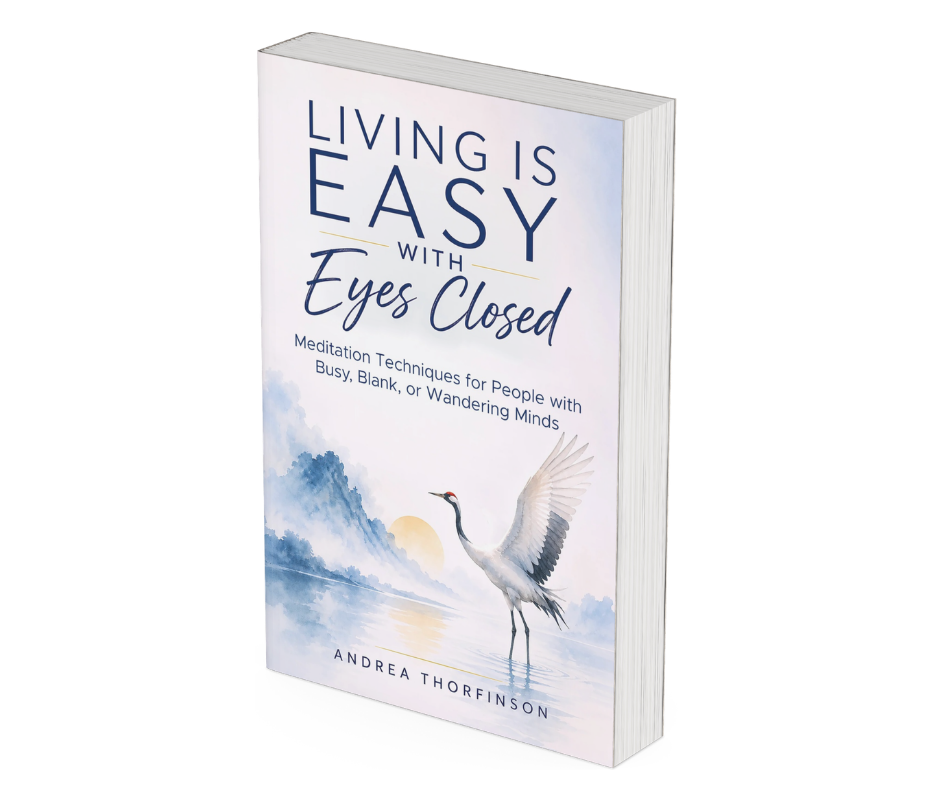
Although my book, Living Is Easy With Eyes Closed, was written for adults rather than children, it explores many of the same simple practices I first shared with Jude: breath, sound, movement, and other nonvisual ways of finding calm.
If you have ever felt that meditation was not for you because you cannot visualize, cannot quiet your mind, or simply do not know where to begin, this book was written with you in mind.
The tools we teach children often begin with the ones we are learning to use ourselves.
Learn more about Living Is Easy With Eyes Closed here.