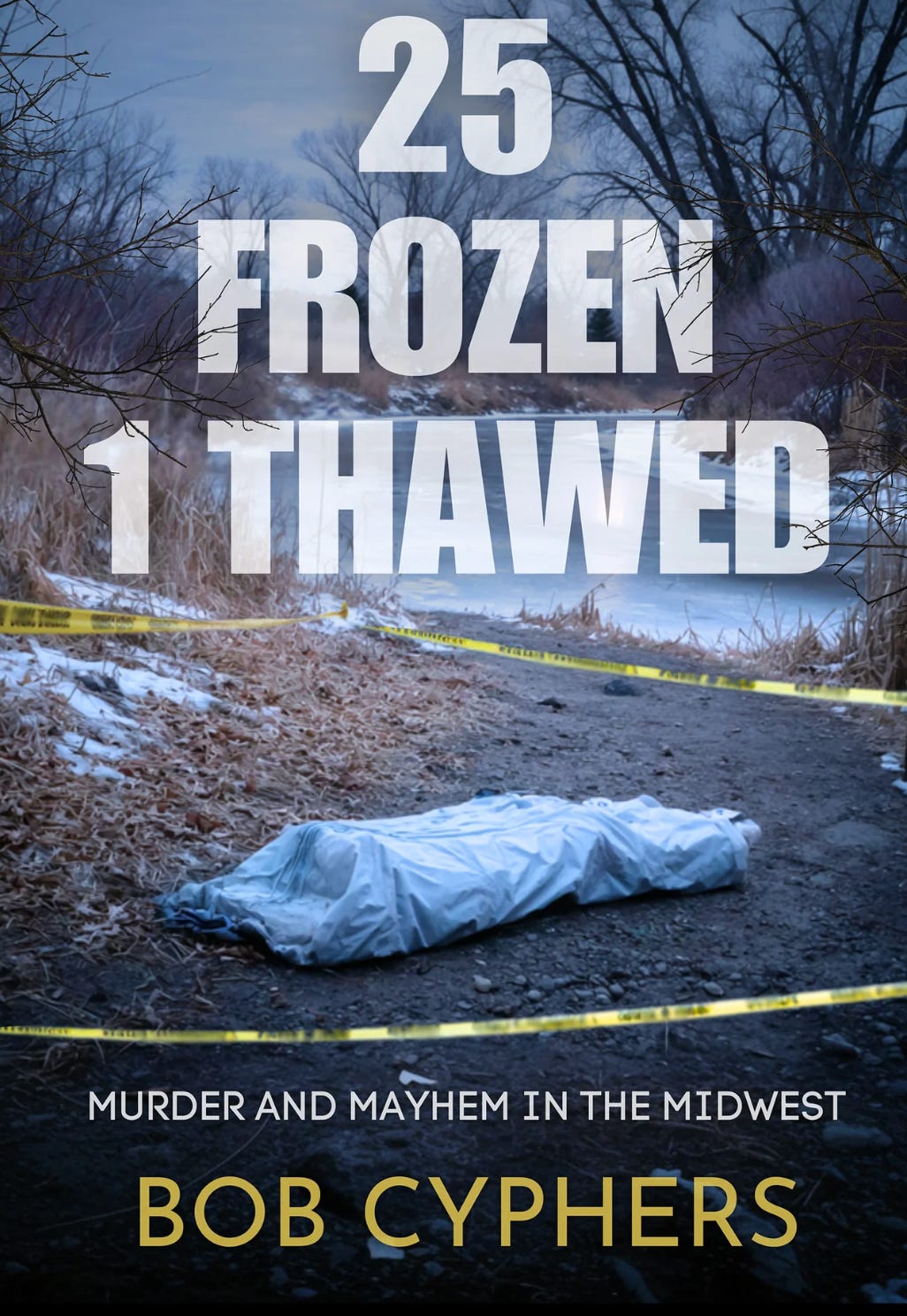
In a tiny Illinois town with one stoplight, a young family was building a quiet life. Keith and Elaine Dardeen had a toddler, another baby on the way, steady jobs, and deep roots in their Baptist church.
Then, in November 1987, all of it was shattered.
The Dardeen family murders remain one of the most disturbing unsolved cases in Midwest true crime history. Years later, serial killer Tommy Lynn Sells claimed responsibility—but one strange detail raised more questions than answers: a set of watermelon ceramics inside the family home.
Was it proof? A lucky guess? Or another cruel twist in a case already full of them?
Read “The Case of the Watermelon Ceramics,” excerpted from Bob Cyphers’ 25 Frozen, 1 Thawed, a collection of chilling Midwest crimes, unsolved mysteries, and stories that refuse to stay buried.
THE CASE OF THE WATERMELON CERAMICS
There’s one stop light in Ina, at the intersection of Main and Third streets. At Uncle Joe’s, you can get a fried bologna sandwich with fried pickles. After that, it’s a gas station, funeral home, antique store, and Baptist church.
Russell and Ruby Dardeen had just moved to town a year earlier, and owned a mobile home on the outskirts of the city. They went by their middle names, Keith and Elaine. They had a three-year-old son named Peter. Keith worked at the local water treatment plant, Elaine at a supply store. The couple was actively involved in the tiny Baptist church, Keith a lead singer, and Elaine playing the piano. Life was drama free in the small town. But there was excitement: Elaine was seven months pregnant with a little girl, who would be named Casey.
And then came November 17, 1987.
Keith failed to show up for work for his night shift, and nobody could reach his family. Concerned, his parents contacted the Jefferson County Sheriff’s Office, and headed south with a key to the trailer. Police met them at the scene. Keith’s car was missing, and they went inside. What they found was indescribable. Elaine was sexually mutilated and bludgeoned to death with a baseball bat. So was her son Peter. Baby Casey, due in two months, arrived during the beatings. She too, was beaten to death. There was no sign of Keith. Police immediately began searching the trailer. No forced entry. Nothing was missing. Cash and jewelry were lying in the open. But the crime scene had another twist: Elaine, Peter and Casey were tucked in, nicely, to their bed.
The police and family asked, where was Keith? A manhunt ensued, as Keith was clearly the number one suspect. A day later, hunters found Keith’s body in a wheat field, a mile away from the family home. He was also sexually mutilated and shot three times in the face.
The family car was still missing. But not for long. The next day, it was found 10 miles south, splattered with blood. Was it burned, or hidden deep in the woods, out of sight from police? No. The killer or killers drove and parked the car right in front of the Benton Police Department. Next door was the Franklin County Courthouse. Thirty detectives worked the case full time. They interviewed more than 100 people. They tracked down more than 1,000 leads, but came up empty.
No suspects were ever identified. There were few leads in the case. Years went by. And then along came Tommy Lynn Sells, who claimed he killed up to 70 people throughout the country. He said his nickname was “Coast to Coast.” investigators on the Dardeen case had never heard of the name Tommy Lynn Sells. But there was a little, or very big problem with the Sells confession: the watermelon.
Sells described a set of watermelon ceramics inside the Dardeen home...
Get the book here: 25 Frozen, 1 Thawed