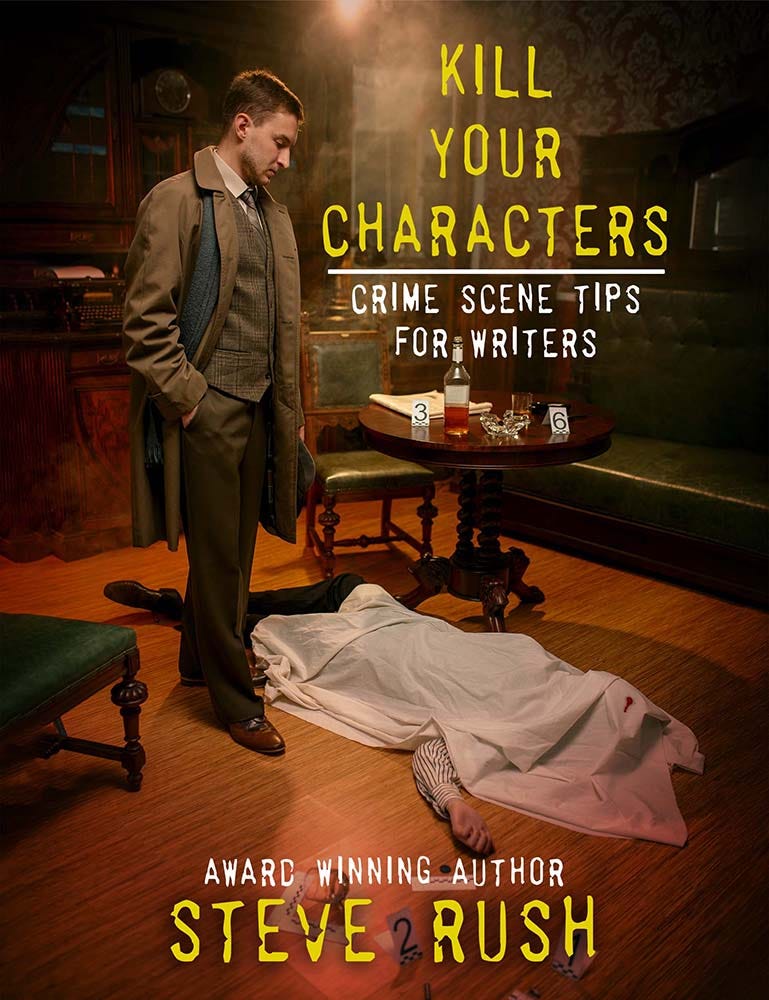
From Hollywood dramatizations to gritty novels grounded in fact, the debate rages on: Is the book always better? Donnell Bell explores why readers often find crime fiction more authentic than its cinematic counterparts and highlights how writers can raise their game with realism. Featuring tips from Steve Rush’s Kill Your Characters, this article is a must-read for thriller and mystery authors.
Blog Article for Donnell Bell
The Book Was Better
Producers, directors, and actors deliver sight and sound in movies and television shows not available in novels no matter how well we write them. They invite us into a world filled with on-screen action and special effects accompanied by emotion-evoked soundtracks. The use lighting, camera angles, and other attention-drawing behavior for dramatic effect.
Many theatrical releases and made-for-television movies and series are based on novels. Yet, we hear comments from readers who opine, “I read the book. I saw the movie. The book was better.”
Why are some novels considered better? Novels (especially crime fiction, suspense, and thrillers) rank higher based on their sense of authenticity and credibility. Think about it. How many cinematic portrayals of inciting incidents, crime scenes, and law enforcement responses and actions included parts believed improbable and unlikely compared to the real-world?
Hooray for writers who research, show, and offer thought-provoking and emotion-evoked effects in their short stories, novellas, and novels. Readers prefer to lose themselves in the worlds created by authors who produce works filled with authenticity and credibility.
I have read books on craft written by successful writers and have taken online classes to improve my works in progress. Those most helpful to me are: Story Trumps Structure, Steven James; On Writing: A Memoir of the Craft, Stephen King; How to Write Best Selling Fiction, Dean Koontz; Plot and Structure, James Scott Bell; and On Writing Well, William Zinsser.
Craft alone proves not enough. Readers know if and when we fail to include the correct facts in our stories. Along with craft, we strive for authenticity, believability, and credibility to keep readers turning pages. Accuracy in our prose reflects credibility and enhances belief. Facts support our efforts. Facts paint the images we want readers to see as if everything happens in their presence. In crime fiction, suspense, and thrillers, we show readers how to kill. We show them how to collect evidence, how to investigate deaths, and how to put together a case for prosecution. Each endeavor must embrace appropriate facts. Facts validate scenes.
Details in fiction reflect real-world situations. Unbelievable instances in life frequently prove to be true, although many come as a surprise. When readers see events as too easy and convenient, skepticism turns focus away from the story. Like Jack Webb’s character Joe Friday in the TV series Dragnet, “All we want are the facts.”
The facts in our stories must relate to reality if we want readers to keep turning pages. Here are a few examples:
• Will a bullet or shotgun blast knock a two-hundred-pound person off of their feet?
• Are gunshot exit wounds always larger than entrance wounds?
• Does the number of stab or slash injuries offer clues to the assailant’s identity?
• Was the brain injury caused by a fall or a blow to the head?
• Will vehicles explode in a crash?
• How might you determine if a body discovered in a burned building was alive or dead at the time the fire started?
The circumstances and facts offer answers. Further investigation becomes necessary to answer and either prove or disprove each scenario. All the above questions and more are answered in Kill Your Characters, Crime Scene Tips for Writers published by Genius Books.
Here is the blurb:
There’s a dead body on the floor, and your detective character has to learn every detail about the crime in order to solve the case and bring the murderer to justice. If you’re not an experienced forensic investigator, how can you describe the manner of death accurately so that the evidence means what you want it to mean?
Kill Your Characters by former detective and forensic investigator Steve Rush gives you the tools you need to pass the inspection of all the armchair detectives (and more than a few real ones) out there. Discover your ultimate empowerment source for writing the page-turning inciting-incident you have always wanted to write. Become a master and save hours of research effort searching elsewhere for accurate information.
Kill Your Characters will help you answer these questions and more with facts to back up your fiction. When plotting the next murder scene for your story, you may run into obstacles such as how the detectives determine time of death, or the forensic evidence left by a gunshot wound. Steve Rush’s extensive experience is accumulated in a series of writing tips that will significantly improve your story. Kill Your Characters is for any author looking to elevate their murder scenes with credible and authentic details.
Order your copy here: https://www.amazon.com/dp/1947521780
Writing a novel is a process similar to life and our correspondence with our environment. Learn the craft, write, submit, and never give up.
Bio:
Steve Rush is an award-winning author whose experience includes tenure as homicide detective and chief forensic investigator for a national consulting firm. He was once hailed as “The best forensic investigator in the United States” by the late Joseph L. Burton, M.D, under whom he mastered his skills, investigated many deaths alongside Dr. Jan Garavaglia of Dr. G: Medical Examiner fame, and was part of the development team for Quincy Technologies, an automated case management system designed for coroners and medical examiners. Steve has investigated 900+ death scenes and taught classes related to death investigation. His specialties include injury causation, blood spatter analysis, occupant kinematics, and recovery of human skeletal remains.
Two of Steve’s manuscripts placed first and third in the 2022 Public Safety Writers Association Writing Competition. His book Kill Your Characters; Crime Scene Tips for Writers, published by Genius Books on June 7, 2022, tied for first place in the 2022 PSWA Writing Competition’s unpublished nonfiction category. Steve won joint first prize in the 2020 Chillzee KiMo T-E-N Contest and was a finalist in the 2020 Page Turner Awards.
He lives in Metropolitan Atlanta, Georgia, with his wife Sharon.
http://steverushauthor.com/
https://www.linkedin.com/in/steve-rush-a20302149/
https://www.goodreads.com/author/show/5217876