

Writers are often told to “see the scene” before they write it.
But what happens if you can’t?
A question I’m often asked as a writer with aphantasia is how the inability to visualize affects my writing. For a long time, I didn’t have a clear answer.
Growing up, I dreamed of being a storyteller. I was always writing journals, letters, short stories, anything that let me put words on paper, and I could spend hours lost in it, believing I was honing my craft and preparing to one day write the novels I carried in my heart.
I remember sitting in front of the fireplace as a kid, staring into the flames and imagining “fire people” living inside them—tiny beings moving through flickers of light, carrying on lives of their own. Making up stories for them as I watched the flames dance.
I wasn’t seeing them the way others describe visualizing, but I was still creating stories, following ideas, building little worlds, and getting lost in them.
That love of writing never left, even as life gradually pulled me away from it.
Writing Without Visualization
Somewhere along the way, writing slipped out of my daily life. It didn’t disappear all at once, but over time, it became something I used to do instead of something I was actively living.
It wasn’t until my little dog died that I felt the pull to write again—to tell her story not just for myself, but for my children. That story became my first children’s book, and in the process of writing it, I came face-to-face with something I hadn’t fully understood before: the “show, don’t tell” part of storytelling.
The part where scenes come alive on the page, where the reader feels like they’re inside the moment, didn’t come easily to me. And I found myself confronting a gap I didn’t know how to explain.
There were no inner pictures to draw from. No scenes playing out in my mind that I could simply describe.
I hadn’t heard the term aphantasia yet, but I knew something wasn’t clicking the way I thought it should, and I remember wondering, very quietly, whether my dream of becoming a storyteller might be over.
Building Instead of Seeing
What began as a personal keepsake slowly grew into something more, eventually becoming a published story. And through writing it, I discovered something I hadn’t expected:
I could still tell stories—just not in the way I had always imagined I would.
I still needed to create scenes, describe characters, and bring moments to life on the page. But instead of visualizing those scenes internally, I found another way of working, one that relied on looking outward rather than inward.
In this case, I had real images of everything: my dog, my bird, my children, and our home. Instead of trying to picture scenes in my mind, I looked at those photos and described what I saw, using them as anchors to build the story.
Where I had always assumed writers were watching scenes unfold internally and simply writing them down, I realized I was doing something fundamentally different.
I wasn’t retrieving images.
I was building the scene.
And the more I’ve talked to other writers—both with aphantasia and without—the more I’ve realized this isn’t as unusual as I once thought. Many writers rely on references, memory, and observation in ways that aren’t so different from my own process.
What “Show, Don’t Tell” Actually Looks Like
When photos aren’t available, my process shifts, but the underlying approach stays the same.
I start with what I think of as the bones. The basic structure of a scene, stripped of detail:
Mouse went out into the backyard. It was a sunny day. She could see flowers blooming and hear birdsong in the air.
It works in the sense that it communicates the setting, but it still feels flat—lacking the depth that allows a reader to fully step into the moment.
Instead of trying to “see” more, I return to the scene with a different question:
What do I already know from experience?
What does a sunlit backyard feel like?
What details tend to stand out?
What makes a space feel real rather than described?
From there, I reconstruct the scene. Layering in sensation, movement, and specificity:
Mouse stepped off the porch into the backyard, the warmth of the sun-drenched wood seeping into her paws. The grass stretched out in soft green patches, still damp from the morning dew. A gentle breeze moved through the flowers along the fence line, carrying the faint scent of roses. Somewhere overhead, birds chattered back and forth, sharing secrets about the day ahead. Mouse paused, nose twitching, taking it in before trotting forward into the warmth.
This is the part most writing advice skips:
Scenes aren’t always seen.
They’re constructed.
And that construction—whether it starts with an image or not—is where the real work of storytelling happens.
Where I Got Stuck
Finishing that first book gave me a surge of confidence, and storytelling no longer felt out of reach. I wanted to push further, so I turned toward a full-length sci-fi novel—something much larger in scope, with multiple worlds, different realms, and ideas centered around energy, transformation, and growth.
Conceptually, this came easily to me. I could sense how each world functioned, how they differed from one another, and what made them distinct—even without being able to visualize them in a traditional sense.
But when it came to translating those ideas into fully realized scenes, I stalled.
I knew what I wanted in broad terms. I understood the internal logic of the worlds I was creating. But I struggled to move from abstract concept to lived experience on the page.
The issue wasn’t a lack of imagination.
It was the difficulty of shaping that imagination into something structured, detailed, and narratively alive.
What I Know Now
Writing Mouse the Pretty Bird forced me to look more closely at how I actually work as a writer.
I don’t see scenes in my mind. There’s no inner movie playing that I can pause and describe. Instead, I build scenes piece by piece, drawing from memory, sensation, observation, and accumulated knowledge of how the world feels.
And what I’ve come to understand is this:
Writing isn’t about having a movie in your head.
It’s about creating something real enough on the page that someone else can experience it.
Even for writers who can visualize, that process isn’t automatic. It requires intention, structure, and careful attention to detail.
For me, that process comes not from visualization, but from memory, sensation, observation, and meaning. From asking questions. From reconstructing experience. From deliberately shaping each moment until it feels grounded and alive.
It’s slower and more methodical than I once expected.
But it works.
I still struggle with storytelling, and that sci-fi novel remains unfinished—sitting in notes and fragments, pieces of worlds I haven’t yet shaped into something complete.
But I no longer believe the problem is that I can’t see the story before I write it.
The work has never been about seeing.
It’s about building.
Final Thought
If you’ve ever felt like you’re “doing it wrong” because you can’t clearly visualize your scenes, you’re not alone—and you’re not missing anything essential.
Start with structure.
Layer in sensation.
Build from what you know.
Storytelling doesn’t begin with sight.
It begins with creation.
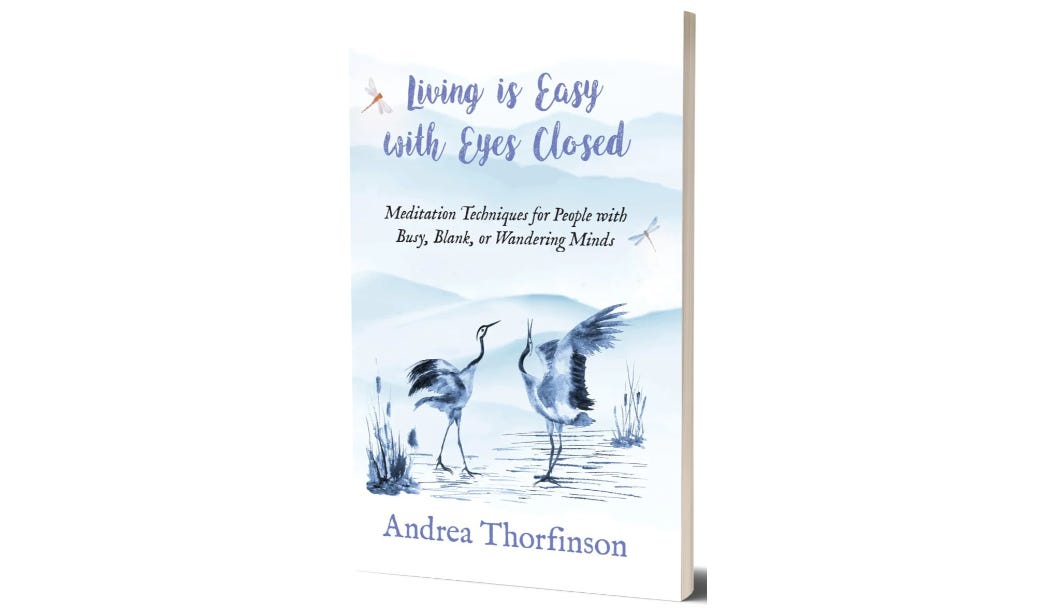
I explore the way the mind works more deeply in Living Is Easy With Eyes Closed, where I challenge common meditation myths and offer an approach that doesn’t rely on visualization.
If you’ve ever felt like you’re “doing it wrong,” it might resonate.
As a fellow aphantastic writer, I agree with the building thing, but honestly I think that in some ways aphantasia helps us.
See, whenever, throughout my life, I've been told to 'picture' or 'visualise' something, I've automatically described it to myself in detail. The truth is I only recently discovered that other people literally meant they could see it. I simply didn't know that was a thing until a few years ago. So, it turns out I have far more experience of composing detailed mental descriptions than most folk, and that's a pretty useful skill for writing of any kind.